

Article

48V instead of 12V: DC-DC converters in focus of the SDV

The vehicle of tomorrow integrates multiple voltage levels. 12V, 48V as well as high-voltage 400V and 800V systems increase the complexity of the electrical architecture.

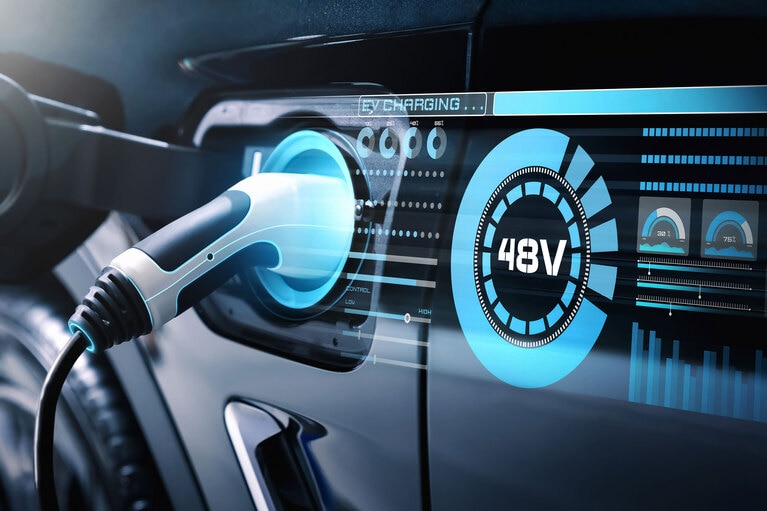
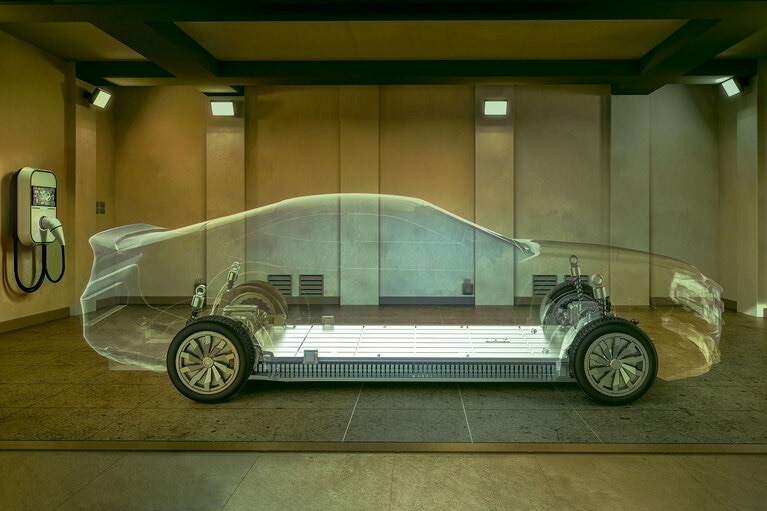
48V electric car image

Q&A with Andreas Wisser, VP EMEA Sales and Marketing, and Haris Muhedinovic, Engineering Manager EMEA

The vehicle of tomorrow features more than a single voltage rail: 12V, 48V and high voltage at around 400V or 800V. DC-DC converters are indispensable for efficiently converting energy between these DC voltage rails. We spoke with Haris Muhedinovic, Engineering Manager at Vicor EMEA, and Andreas Wisser, VP EMEA Sales and Marketing at Vicor, about power in the SDV, safety, redundancy, batteries, DC-DC converters and much more.

Q: How is business going?

A: We are satisfied, as we have strong cooperation and partnerships with OEMs. One of our key strengths is our close proximity to OEMs. At the same time, OEMs value our flexibility. They do not want just any DC-DC roadmap; instead, they tell us very specifically what ideas they have and what they need. This is where our modular approach comes into play.

DC-DC converters as the foundation of zonal architectures

Q: How do we power the SDV?

A: DC-DC converters are the enablers and the foundation of the power supply in a zonal architecture, and this architecture is the backbone of the software-defined vehicle. Every zonal controller requires a DC-DC converter because each controller needs power that comes directly from the high-voltage rail. With our technology, the power supply can be realized in a very small footprint. We provide a turnkey, flexible power solution that OEMs and Tier-1 suppliers can rely on.

Q: How does a traditional approach differ from your approach, for example in active air suspension systems?

A: The conventional approach for active air suspension operates on the 48-V rail. This requires a supercapacitor and/or a battery in addition to the DC-DC converter. Our solution is based purely on a very fast DC-DC converter, meaning neither a supercapacitor nor a separate battery is required. This results in lower maintenance effort, longer service life and eliminates issues related to a charged supercapacitor. While Vicor’s DC-DC converter can convert energy directly to the high-voltage battery, a supercapacitor may already be fully charged. It is no longer necessary to keep the supercapacitor or the 48-V battery at a specific charge level, because our DC-DC converter can immediately deliver up to 3.5kW or even 5kW. With a bidirectional module, we can cover more than 90 percent of all active damping systems.

Q: You mentioned a modular approach – what exactly does that mean?

A: For the key areas we already have suitable modules available, for example from high voltage to 48V or 12V, from 48V to 12V, or from 800V to 400V. This makes it easy to implement several main voltage rails: high voltage, 48V and 12V. If an OEM wants to retain an existing 48V-heating systems, -active suspension or other -systems but migrate the battery incl. traction voltage to 800V, this can be achieved with relatively little effort. Other voltage levels are also possible. OEMs can implement a highly flexible bidirectional solution that allows them to cover a wide range of power-network requirements and implement them quickly. In principle, only one high-voltage battery of 800 or 400V is required. Every other rail, such as 48V or 12V are handled entirely by fast DC-DC converters.

There are now many applications in vehicles that operate more efficiently at 48V. Using the appropriate converter modules, the isolated load can always receive the required power at 48V – either from the high-voltage rail or from the 12-V rail. For example, in a 48-V steering system the high-voltage rail could supply the primary power via the appropriate converter, while the 12-V rail serves as a backup. It is even possible to maintain the charge level of a hybrid vehicle’s high-voltage battery via the 12-V cigarette-lighter socket; the DC-DC converters are capable of doing this.

What role will 48V play in the vehicle electrical system of the future?

Q: What impact will this have on the onboard power network?

A: We believe the future belongs to the 48-V rail and that 48V will become the dominant low-voltage level in vehicles. In other words, 48 volts will be the new 12 volts, although 12V will continue to exist. In the long term, the 12-V battery will disappear from vehicles and be replaced by a 48-V battery. All safety-relevant applications will run on 48V, and from a safety architecture perspective these systems definitely require a redundancy in energy supply, either with 48V battery or another DC-DC converter from HV to 48. Because the remaining 12-V consumers will no longer be safety-critical, vehicles with a high-voltage rail will no longer require a dedicated 12-V battery. DC-DC converters will then provide the 12V required for certain subsystems.

Q: Where will 12V continue to play a role?

A: There will still be several domains that operate at 12V. Good examples include door modules, interior lighting and other loads with relatively low power consumption. At present, legacy systems simply do not yet allow a complete transition from 12V to 48V. However, this voltage can be easily provided using compact 48-to-12-V regulators. Such a converter can be placed upstream of a legacy control unit operating at 12V. Even in high-performance applications we can efficiently provide the required voltage at high currents by converting directly from 48V to 1V or even 0.8V at the point of load (PoL). Current multipliers or sinusoidal amplitude converters – also known as SACs or resonant converters – are the preferred approach. The challenge always lies in high currents, because according to the formula P=I2×R the losses increase quadratically with current. It is therefore better to distribute the higher voltage of 48V all the way to the electronics and then use a highly efficient PoL regulator there. This concept is known as Factorized Power Architecture. “Factorized” refers to fixed conversion ratios, such as a factor of four between 48V and 12V or a factor of 48 when converting from 48V to 1V. Essentially, these factorized-ratio converters function much like a transformer, which also has a fixed turns ratio and therefore a fixed conversion ratio. In simple terms, they can be described as DC transformers.

Q: Why are these DC transformers still rarely used in designs today?

A: Conventional converters required a considerable amount of space, and their efficiency was not always optimal.

Vicor has now changed this with the BCM series. These factorized-ratio converters deliver efficiencies of up to 98 percent despite their very small footprint. Our engineers work closely with the manufacturing department, because managing 3.5 kW of power in such a small package is not trivial. Thermal optimization is particularly important, both at converter level and at system level. However, we have solved these challenges, and we also have the parasitic inductances and capacitances well under control. All our magnetic components are planar, which means we can reproduce magnetic values with 100 percent automation. The distance between the primary and secondary sides, or between individual layers, always remains the same. Since we do not need to wind coils, the typical winding-related challenges disappear as well. As a result, we have full control of the design at board level.

Synergies with data centers: from 800V via 48V to sub-1-V levels

Q: What role do wide-bandgap semiconductors such as SiC and GaN play here?

A: We use both silicon MOSFETs and gallium-nitride MOSFETs, and we are currently working on developing entirely new technologies of our own. In data centers there is also a trend towards converting directly from 800V to 48V or even lower voltages close to the point of load. What synergies exist with the automotive sector?

Yes, in high-performance computing 800V also appears to be becoming the backbone – just think of the architectures being driven by Nvidia. From the high-voltage level the power always goes via a 48-V intermediate stage. For high-voltage safety reasons alone, galvanic isolation and touch protection are required. However, right next to it the converter from 48V to 0.9V can already be located. We are receiving increasing inquiries from the data-center sector. This is beneficial not only for efficient high-volume manufacturing but also because designs developed to automotive quality standards are entering the high-performance computing domain. If you increase efficiency by just a few percent in computer racks with power consumption in the megawatt range, this not only reduces the electricity costs of the servers themselves. Cooling costs – the removal of waste heat – are also reduced significantly, which makes a major difference.

Q: What do automakers and Tier-1 suppliers require when it comes to DC-DC converters?

A: We maintain very close partnerships with various OEMs. In addition to hard technical factors such as efficiency, thermal management and size, other aspects are equally important. For example, we help reduce the number of variants as much as possible. With our modular solution, OEMs can use a predefined footprint and select different power classes such as 2kW, 4kW, 6kW or even 10kW in order to cover different product segments with a common base configuration – while maintaining full software compatibility. OEMs increasingly want to differentiate themselves in terms of performance, ranging from the electric motor and traction inverter to the battery including battery management and the individual DC-DC converters. They want more than just COTS (components off the shelf) – in other words, more than standard components. Packaging space is extremely important as well, because space is limited and thermal management is a real challenge. This is exactly where our solutions come in. In many cases, a vehicle design requires a high peak power of, for example, 5kW, but only for a maximum of five percent of the time. Traditionally this leads to the use of a converter that is significantly oversized, or a supercapacitor that is dimensioned accordingly. With the new modules these peaks can be absorbed more effectively. Naturally the module warms up, but our 3.5-kW module, for example, operates at 0.1K/W, allowing it to deliver peak power for a considerable period of time. Without a heatsink we can deliver 1.3kW for six minutes, which means that in many cases neither a supercapacitor nor a buffer battery is required. These BCM6135 DC-DC converters have recently entered series production in several brand-new vehicle models. The Vicor BCM6135 is currently the most powerful and fastest DC-DC converter for converting high voltage to SELV (Safety Extra Low Voltage – up to 60V) and acts as a catalyst for new innovations in vehicle power supply systems.

Q: How well are these new solutions being accepted when it comes to series production?

A: In Europe, commercial framework conditions often mean that these innovations fall by the wayside during the transition to series production when compared with existing solutions. In Asia, however, entirely new products are making it into series production. That is typical of the China model: they introduce innovations first and focus on cost optimization afterwards. Europe, on the other hand, comes from a legacy of cost-optimized supplier models and generally only accepts innovations if they also deliver an immediate cost advantage. As a result, innovations cannot currently be implemented as quickly in Europe as in other regions.

Q: What technical specifications are we talking about when it comes to power for SDVs?

A: One key factor is fast response to current changes, which is why di/dt values of around 500kA/s are often required. When our module switches at 1.3 or 1.5MHz, achieving this is no problem. Bidirectionality is also important in order to enable recuperation of 12-V loads. Unlike a 12-V battery, our converters are not temperature-dependent; they can deliver di/dt values of up to 8MA/s even at temperatures ranging from −20 or −40 °C to +80 °C. Because of the fixed conversion ratios in the Factorized Power Architecture, a capacitance of 1μF on the 48-V rail results in 16μF on the 12-V rail, which helps reduce costs. A 3.5-kW module weighing just 65 g that converts from 800V to 48V can now operate with efficiencies of more than 98 percent and still achieve over 97 percent at full load. When these aspects are considered from a top-down perspective within the overall system architecture, the technical parameters form a coherent picture. Ultimately, the power design must not become the limiting factor for future performance upgrades.

Andreas Wisser is the VP EMEA Sales & Marketing representing VICOR based in Ismaning, Germany. With over 30 years of experience in sales and marketing in the semiconductor industry, he is responsible for the EMEA region developing and deepening the VICOR customer relationships and driving the regional business development. He holds a Master’s degree of Electrical Engineering from FH Cologne and an MBA from Pforzheim University.

(Author's name goes here)

Andreas Wisser, VP EMEA Sales and Marketing

Haris Muhedinovic works with OEMs and TIERs to design and develop highest performance power solutions for most demanding automotive applications. With his interest in power electronics and electronics systems, Haris is aware of new technologies and trends in industry, which allows him to implement power solutions to meet the most demanding specifications. Haris received his MSc from the University of Sarajevo and has 7 years of experience in power electronics in design and application engineering.

Ken Coffman

Haris Muhedinovic, Engineering Manager EMEA

资源