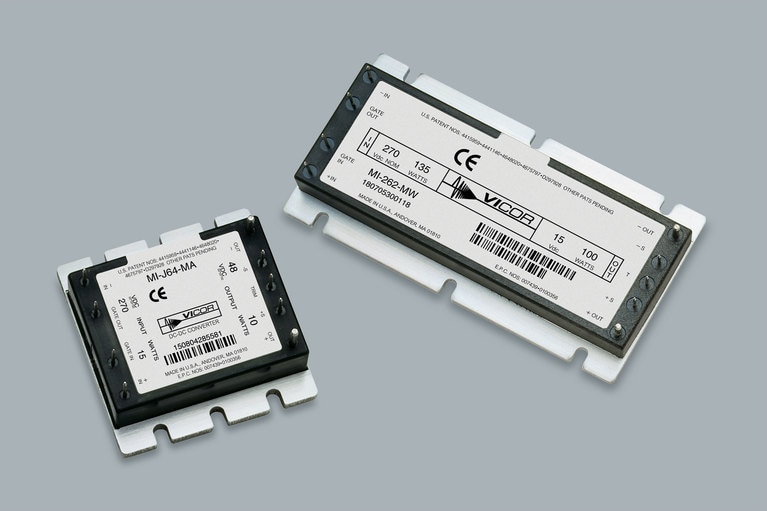
Military COTS MI-MegaMod Family DC-DC Converters

Product Image
Quick Links

Related Products

Value Added Resellers (VARS)
Custom Turnkey Solutions

Can’t find a match for your specs? We can design and manufacture turnkey custom power systems that meet your specific needs!

Vicor's experienced Application Engineers are here to help.
For help with product selection and availability, placing an order and order status:
phone Image 800-735-6200
Ask about our Express Order Program - Great for Prototype Samples!
Helps you optimize your design and accelerate the prototyping process
Contact Us  »

Every MI Family module undergoes extensive post-production environmental stress screening (ESS) before shipment to verify compliance with Vicor's high quality and performance standards and to eliminate early life failures.

The current program of unpowered temperature cycling and dynamic power cycling burn-in is the result of years of test data analysis, process improvement, and screening strength calculations based on DOD-HDBK-344A, Hughes Model RADC-TR-86-149, and IES ESSEH Guidelines. To ensure the most effective routine for precipitating module failures, Vicor continually evaluates its ESS program and makes appropriate changes as new data become available or as product improvements occur. After burn-in and temperature cycling, each module undergoes final electrical testing over the specified temperature range. The program is outlined below.

MI-Family Module Screening    I-Grade   M-Grade
Operating Temperature Mi-200 -40°C to +85°C   -55°C to +85°C
Mi-J00 -40°C to +100°C   -55°C to +100°C
Storage Temperature Mi-200 -55°C to +100°C   -65°C to +100°C
Mi-J00 -55°C to +125°C   -65°C to +125°C
Temperature Cycling
       
17°C per minute nominal rate of change,
dwell time until product stabilization.
  12 cycles
-65°C to +100°C
  12 cycles
-65°C to +100°C
Ambient Test @ 25°C
  Yes   Yes
Power Cycling Burn-In
       

-  Power on 10 min., off 15 min.
-  Module temperature cycling 35°C to 80°C
-  Load up to 100 W

Module output continuously monitored while enabled

    12 hours, 29 cycles    96 hours, 213 cycles
Functional and Parametric ATE Tests        
Low & high temp.     -40°C to +85°C     -55°C to +85°C
AC Hi-Pot Test   Yes    Yes
Visual Inspection        
Before packing into ESD containers
  Yes   Yes


Fully encapsulated, Vicor's MI-Family modules utilize a proprietary spin fill process that assures complete, void free encapsulation making them suitable for the most harsh environments. In addition to providing mechanical rigidity,the encapsulant is thermally conductive to eliminate hot spots and aid in heat transfer to the baseplate. Two grades, I & M, are available with temperatures to -55°C operating and -65°C storage.

To verify the suitability of Vicor's MI Family products for harsh environments, MI-Family modules have been subjected to the environmental testing requirements of MIL-STD-810 and MIL-STD-202. These tests, listed below, are performed at an independent laboratory. Additional environmental tests can be done upon individual customer request. Some of those performed for specific customer applications include ESD (DOD-HDBK-263), Structure Borne (Acoustic) Noise, Transportation Vibration, Flammability, Terminal Strength, Thermal Shock, and Power Conditioning. Contact the factory for details.

Altitude
-  MIL-STD-810D, Method 500.2, Procedure III, explosive decompression (40 K ft.).
-  MIL-STD-810D, Method 500.2, Procedure II, 40,000 ft., 1000 – 1500 ft./min. to 70,000 ft., unit functioning
 
Explosive Atmosphere
- MIL-STD-810C, Method 511.1, Procedure I
 
Vibration
- MIL-STD-810D, Method 514.3, Procedure I, category 6, helicopter, 20
- MIL-STD-810D, Method 514.3 random: 10 – 300 Hz @ 0.02 g²/Hz, 2000 Hz @ 0.002 g²/Hz, 3.9 total g rms
  3 hrs / axis Sine: 30 Hz @ 20 g, 60 Hz @ 10 g, 90 Hz @ 6.6 g, 120 Hz @ 5.0 g, 16.0 total g rms, 3 axes

- MIL-STD-810E, Method 514.4, Table 514.4-VII, ±6 db/octave, 7.7 g rms, 1hr/axis
 
Shock
- MIL-STD-810D, Method 516.3, Procedure I, functional shock, 40 g
- MIL-STD-202F, Method 213B, 18 pulses, 60 g, 9 msec
- MIL-STD-202F, Method 213B, 75 g, 11 ms saw tooth shock
- MIL-STD-202F, Method 207A, 3 impacts / axis, 1, 3, 5 feet
 
Acceleration
- MIL-STD-810D, Method 513.3, Procedure II Operational test, 9 g for 1 minute along 3 mutually perpendicular axes
 
Humidity
- MIL-STD-810F, Method 507.4, 95% Relative Humidity
 
Solder Test
- MIL-STD-202, Method 208, 8 hr. aging
 
Fungus
- MIL-STD-810C, Method 508.1
 
Salt Atmosphere
- MIL-STD-810C, Method 509.1


Because operating temperature is one of the most important factors in determining overall module reliability, it is imperative that the user's system design allow for efficient heat transfer from the baseplate to system ambient. Since temperature and failure rate are exponentially related, just a 10°C decrease in baseplate temperature can have a dramatic increase in MTBF. Due to patented zero-voltage/zero-current switching topology, Vicor converters are highly efficient compared to those with more traditional topologies. High efficiency translates into both smaller size and lower temperature rises. To minimize thermal impedance, all major power dissipating components are mounted directly to the baseplate.

Below are representative calculated MTBF values based on MIL-HDBK-217F. If you require information about a specific model, contact Vicor with the model number, expected baseplate temperature, and operating environment to obtain an individually prepared report.


  Model Number Baseplate Temperature MTBF in 1,000 Hrs.
G.B G.F. A.I.C. N.S.
  MI-J71-MY 25°C 3,778 1,894 1,136 1,117
50°C 2,311 1,155 693 682
65°C 1,780 890 534 525
  MI-276-MW 25°C 3,755 1,878 1,127 1,108
50°C 2,291 1,145 687 678
65°C 1,765 882 529 521


Drawing Number
  Description     Technical Drawing            
10874   Outline Drawing for MI-MegaMod     PDF | DXF            
07045   Outline Drawing for MI-MegaMod Jr. 1-Up     PDF | DXF            
07494   Outline Drawing for MI-MegaMod Jr. 2-Up     PDF | DXF            
07495   Outline Drawing for MI-MegaMod Jr. 3-Up     PDF | DXF            

PowerBench™– MegaMod / MI-MegaMod Product Configurator »
With this configurator you can select input voltage, output voltages, power levels, temperature grades and then a part number, price, and delivery date will be displayed.

MI-IAM – Input Attenuator Module - DC Input, front-end modules providing transient protection, inrush current limiting and EMI filtering for MI-200 and MI-J00 DC-DC converters.

MI-RAM – Ripple Attenuator Module - MI-RAM may be connected to MI-200 or MI-J00 converters with output voltages from 5 – 50 Volts, to limit total output noise to less than 3 mV peak-to-peak at loads up to 20 Amps.

MicroRAM – Ripple Attenuator Module - The MicroRAM combines both active and passive filtering to achieve greater than 40 dB of noise attenuation from over a range of 3 – 30 Vdc.

MI-AIM – AC Input Front-End Module  - The MI-AIM is an AC front-end module which interfaces directly with AC mains to provide line rectification, EMI fltering, transient protection, and inrush lmiting.

MIL-COTS Maxi, Mini and Micro DC-DC Converters - Our Maxi, Mini and Micro models (full, half, quarter-brick) DC-DC converters feature a patented low noise design with the highest reliability and power density available.

MI-200 / MI-J00 DC-DC Converters - The MI-series is designed for MIL-COTS applications utilizing distributed power architecture and is based on Vicor's zero-current switching, component level DC-DC converters.

MIL-COTS VIPAC Array – Chassis Mount DC-DC Converter - VIPAC Arrays are a highly flexible 24 and 300 Vdc inut power system that can be configured with as many as four user-definable outputs, with power capability, up to 750 W.