

获取免费的汽车电子书:高功率电源转换:更小的体积,更大的功率。立即下载

Article

Bidirectional power and transient speed
enable scalable active suspension

Powering active suspension effectively has been challenging since it earliest inception decades ago. For that reason it has been a feature limited to luxury automobiles. Today, with the move to 48V and the use of high density power modules, the barrier to broader adoption is being eroded.

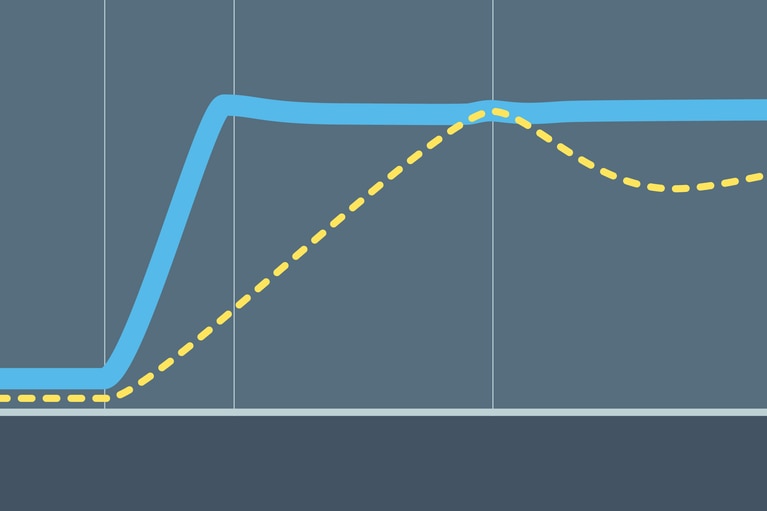
Transient speed image

Sine Amplitude Converter™ modules offer a unique combination of bidirectionality and transient response that unlocks new possibilities for active suspension.

Active suspension has long been synonymous with luxury vehicles, but today the technology is beginning to appear across a broader and more accessible range of platforms.

However, supporting this expansion requires automotive power architectures that are far more flexible and responsive than what has historically been the industry standard.

At the highest level, suspension control requires an underlying power system that can support an instantaneous bidirectional current flow direction change and high-speed transient response. A system that cannot reverse current direction or deliver power instantly may fail to stabilize the vehicle chassis during road disturbances or miss the opportunity to recover energy during rebound.

Unfortunately, traditional power electronics built around regulated DC-DC converters, buffered energy storage and 12V rails struggle to meet the fast-paced demands of suspension actuators without major weight and size increases.

Instead, Power modules based on Vicor Sine Amplitude Converter (SAC™) technology directly address both challenges by enabling symmetrical energy flow without switching overhead and delivering current with nearly zero delay regardless of dynamic load conditions.

The result is a power delivery system that operates more like a direct extension of the battery than a conventional voltage regulator.

Bidirectional flow without software control or switching logic

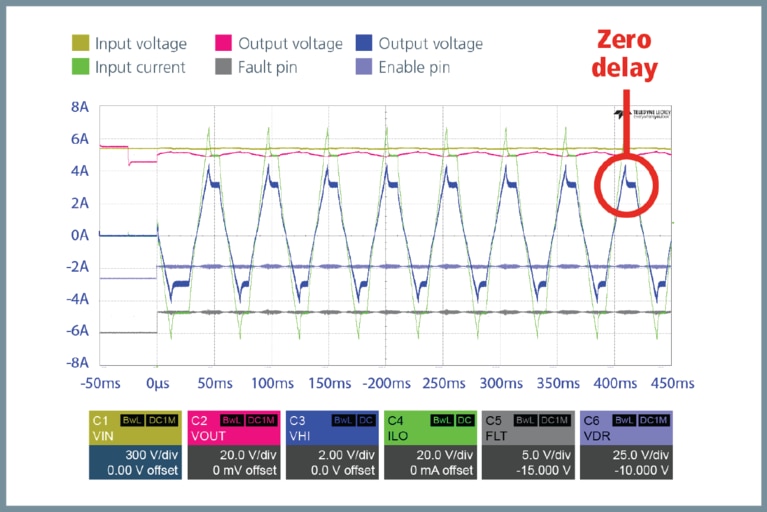
Suspension actuators are among the few vehicle subsystems that must operate as both a load and a generator. The current flowing into a linear actuator during road compression can reverse direction milliseconds later as that same actuator rebounds and harvests kinetic energy. This is why support for bidirectionality is so important for the underlying power system. Without a converter that can accommodate fast and smooth current reversal, much of this regenerative energy would be wasted or require dissipation through resistive loads (Figure 1).

SAC-based converters are inherently symmetrical in their behavior. Because they operate with a fixed voltage transformation ratio and use soft resonant switching, current can reverse without the need for explicit control logic. There is no pin toggling, no microcontroller intervention, and no software-defined routing between source and sink paths.

This behavior is rooted in the physics of the converter itself. As the 48V low-side voltage rises (i.e., due to regeneration), the converter naturally reflects that back to the high side. In other words, when the resulting voltage exceeds the battery rail, current flows upstream. Conversely, when the suspension draws power, the converter steps down from the battery rail with no reconfiguration. In that way, a single converter can support both directions of current flow without interruption (Figure 1).

BCM zero delay bidrectional operation chart image

Figure 1:  Laboratory testing of Vicor BCM® modules shows bidirectional operation with zero delay between input and output.

Conventional regulated converters, on the other hand, are not inherently bidirectional. To feign bidirectionality, such systems employ parallel buck-boost or regulated dual-path designs that increase the bill of materials (BOM), board area requirements and system complexity. These architectures then rely on the cumbersome process of actively detecting current transitions and responding via software or analog control loops to reestablish a stable output. During that time, regenerative energy is either lost or shunted into local buffers. This latency reduces overall system efficiency while also forcing designers to include additional components that increase size, weight and system complexity.

Bidirectional SAC modules avoid this entirely. Their behavior is immediate and autonomous, enabling high energy capture efficiency without complexity. In practical terms, this makes it possible to eliminate the dedicated circuitry and firmware that previously managed direction control. It also removes the need for redundant converter pathways or additional current sensing.

Ultimately, the bidirectional capability is a function of the converter’s resonant, passive behavior, not an orchestrated response managed by a controller.

This performance also has implications beyond active suspension. Any subsystem with bidirectional current behavior like steering assist, regenerative braking, chassis leveling or thermal pump backflow can benefit from such a simplified flow. In this way, bidirectional SAC modules provide a means to unify power flow design across these subsystems, thereby reducing the architectural complexity of zonal power domains within the vehicle.

Transient response without output filters or buffers

Fast transient response is the second non-negotiable requirement for active suspension. The suspension system must react to rapid mechanical inputs from the road, sometimes within microseconds. During such events, the power system must be able to source or sink current without delay, droop, or overshoot.

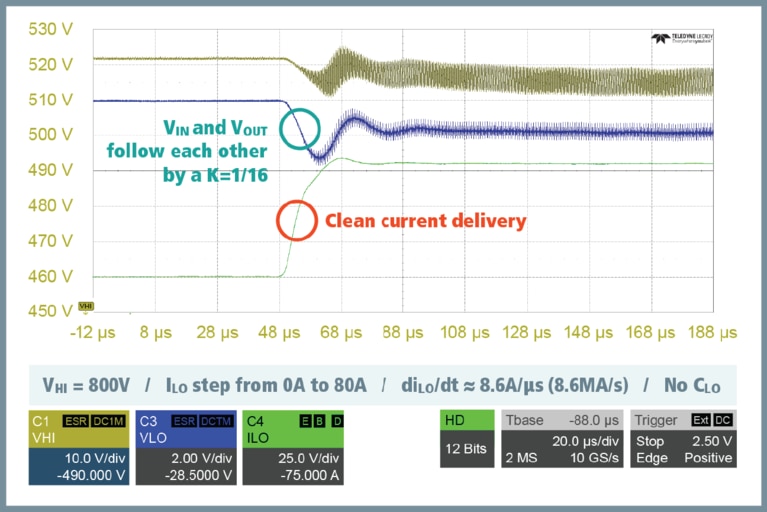
SAC modules deliver this responsiveness directly. Operating at resonant frequencies with minimal parasitic elements, SAC-based power modules exhibit current slew rates exceeding 8 million amps per second (Figure 2).

Laboratory testing of Vicor BCM modules shows how Sine Amplitude Converter™ modules image

Figure 2:  Laboratory testing of Vicor BCM modules shows how Sine Amplitude Converter™ modules are capable of achieving slew rates exceeding 8MA/s.

Notably, this performance is achieved without the use of output inductors, capacitors, or local energy storage. Instead of relying on energy buffering to smooth voltage and current transitions, SAC™ converters use a high-Q resonant tank to transfer energy efficiently and predictably between the primary and secondary sides. The result is a power path with extremely low output impedance and negligible phase lag, allowing the system to respond to load steps as rapidly as the control system can command them without energy lag or overshoot effects common in filtered designs.

This responsiveness is a major advantage for the control loops that govern electromechanical suspension. The closed-loop stability of such systems depends on electrical latency staying below the mechanical response time of the actuator and vehicle mass. When the electrical system can keep up, more aggressive damping algorithms can be deployed, yielding better handling, reduced body roll and faster recovery from potholes or lane changes.

Another advantage of filter-free transient performance is volume reduction. Output capacitors and inductors at the power levels used in suspension systems are physically large and difficult to cool. Their removal translates directly to smaller enclosures, fewer thermal management constraints and better placement options within the chassis.

The combination of bidirectionality and transient response also creates opportunities for new design roles. These same modules can be used to precharge the high-voltage traction bus from a 48V source, reversing their nominal direction without any firmware intervention.

What happens when you combine bidirectionality and speed?

When bidirectional flow and fast transient response are treated as primary design constraints, the system architecture becomes significantly simpler. SAC converters eliminate the need for multiple power stages, bypass the need for intermediate batteries or super-capacitors and remove the requirement for parallel buck-boost or regulated dual-path designs.

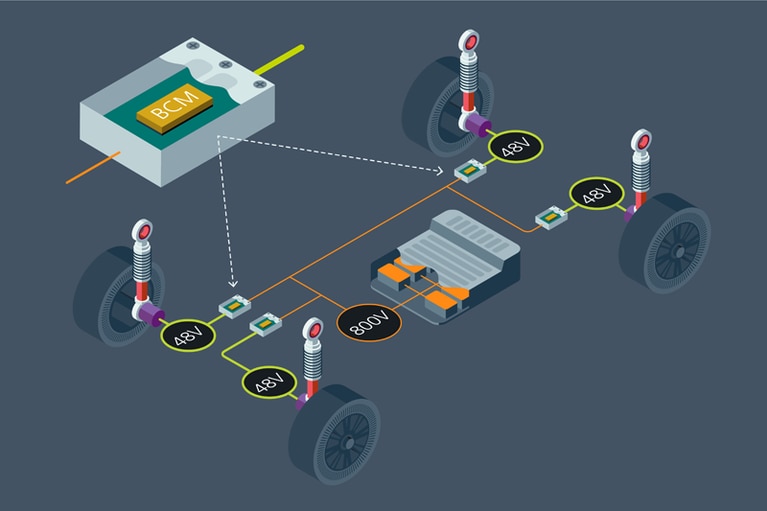
In a conventional setup, regenerative current may follow a distinct path from actuation current, each with its own switches, protections and timing logic. In SAC-enabled designs, a single fixed-ratio converter handles both seamlessly (Figure 3). OEMs reap the benefits of simplified wiring harnesses and minimized parasitic losses. Such an architecture also improves reliability by reducing the number of control elements and synchronization dependencies.

Sine Amplitude Converter modules can support active suspension power systems image

Figure 3:  Sine Amplitude Converter modules can support active suspension power systems that require bidirectional current flow between the battery and suspension actuators.

This improved design also enables more effective mechanical integration. SAC modules combine high power density (up to 150kW/L) with a compact, thermally optimized form factor that fits directly into existing structures, such as the battery housing or chassis. Their flat, planar surfaces provide efficient thermal contact, while the internal architecture maintains low thermal impedance despite the high component density.

As a result, these modules often match or outperform the thermal behavior of individual discrete MOSFETs, delivering kilowatts of power using only external heat sinks or airflow management.

Scalability is another benefit. Because these converters operate at fixed gain and require no reconfiguration for direction changes or load types, they can be paralleled for higher output or redundancy. In that way, a single module type can be used across an OEM’s entire vehicle platform. For example, the same unit can power a lightweight front suspension in a crossover or a dual-motor rear axle suspension in a commercial van, with differences in performance handled by quantity and cooling method rather than design changes.

The combination of bidirectionality and transient response also creates opportunities for new design roles. These same modules can be used to precharge the high-voltage traction bus from a 48V source, reversing their nominal direction without any firmware intervention. They can also serve as the primary conduit for 48V zonal power distribution, where they can manage other dynamic and bidirectional power profiles applications like electric pumps, compressors, and thermal systems.

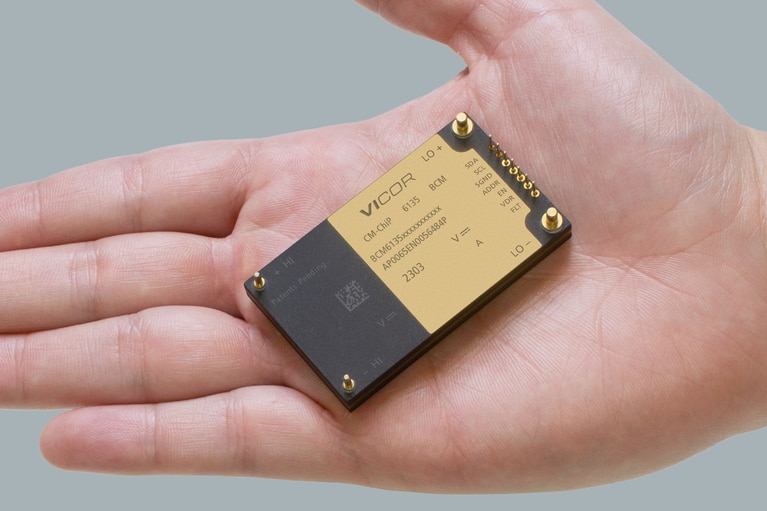
BCM6135 in hand

Bringing active suspension to the masses

Bidirectional power flow and fast transient response are both necessary to bring active suspension systems to a wider range of vehicles. And, when compared to traditional power architecture and solutions, SAC™ converters offer a clear and superior path forward.

Currently, Vicor is the only company offering SAC-based power modules at scale. Solutions like Vicor BCM® modules offer an extremely unique combination of response time, bidirectionality, efficiency, thermal robustness and power density that unlocks new possibilities for designers. By centering the design around SAC-based modules, engineers can create suspension architectures that are lighter, faster, and more energy-efficient, while also being easier to integrate and scale. Through such solutions, OEMs can introduce active suspension to a wider market in a way that is both technologically and economically viable.

This article was originally published by Power Electronics Magazine.

资源