



Arrow: Driving the future of industry in robotics, industrial IoT, and intelligent automation seminar 2026
Industry-leading power density and innovative architectures of Vicor power modules for robotics, industrial IoT, and intelligent automation


Spacechips and Vicor collaborated to create the AI1 Transponder, the most power-dense processor board in orbit. Using Vicor's Factorized Power Architecture, the system delivers 133 TOPS for real-time AI tasks like disaster monitoring and debris tracking. This rad-tolerant, compact solution overcomes high-current (130A) challenges, enabling server-class autonomy in small satellites without the latency of ground processing.
By Salah Ben Doua, Principle Applications Engineer
Since 2010 the number of satellites orbiting earth has increased by 25 times. Satellites cost millions of dollars to deploy and are designed to remain in orbit 5 to 10 years, requiring reliable and robust onboard processor systems to support the duration of a mission.
The demand for smaller satellites with increasingly sophisticated computational capabilities is pushing the limits of the latest ultra-deep-submicron FPGAs and ASICs and their power delivery networks. These high-performance processors have demanding, low-voltage, high-current power requirements and their system design is further compounded by the complexities of managing thermal and radiation conditions in space.
Embracing these challenges, Spacechips has introduced its Spacechips AI1 Transponder product, a small, onboard processor card containing an Adaptive Compute Acceleration Platform (ACAP) AI accelerator. The system delivers up to 133 tera operations per second (TOPS) of performance to support new real-time autonomous computing applications, while ensuring the reliability and longevity to complete longer missions.
“Many spacecraft operators simply don’t have sufficient bandwidth in the RF spectrum to download all of the data they’ve acquired for real-time processing,” said Dr. Rajan Bedi, CEO of Spacechips. “An alternative solution is accomplishing the processing in-orbit and simply downlink the intelligent insights.”
Spacechips is harnessing powerful artificial intelligence compute engines capable of enabling in-orbit AI to address a variety challenges including monitoring mission critical spacecraft system health. AI algorithms can continuously assess the health of onboard subsystems—power, thermal, altitude control and communications—by learning normal operational patterns and detecting anomalies early. Beyond satellite operations, innovative applications address a variety of space-related and Earth-bound problems that benefit from faster communications that enable proactive responses.
AI-equipped satellites can autonomously detect, classify and track space debris when direct line-of-sight communication with Earth is not possible using real-time data captured from onboard imaging sensors. Traditional ground-based monitoring often struggles with smaller, fast-moving fragments, but AI can process sensor input in real-time to predict trajectories and identify collision risks. Neural networks trained in orbital mechanics help refine debris catalogs and update avoidance maneuvers autonomously.
AI on satellites observing the Earth’s atmosphere can enhance the identification and prediction of severe weather events. Instead of simply collecting imagery, an onboard neural network can segment cloud types, estimate storm intensity and flag rapidly forming systems for higher-priority downlink. This allows faster response to severe weather events and improves localized forecasting accuracy, especially over oceans and remote regions where ground sensors are sparse.
Infrared sensors paired with AI can detect temperature anomalies such as wildfires, volcanic activity or industrial accidents. Machine learning models trained on historical patterns can distinguish between benign heat sources and emerging “flashpoints,” enabling near-real-time alerts to disaster response agencies. Predictive modeling also helps identify regions at elevated risk before ignition occurs, allowing for preemptive action.
AI can combine multispectral imaging, GPS-tagged agricultural zones and rainfall data to assess crop health, yield potential and water stress. Models can distinguish between soil moisture variations, nutrient deficiencies and disease indicators. When fused with climate and precipitation inputs, onboard AI can deliver rapid, localized agricultural intelligence to governments and farmers, supporting sustainable food production and resource allocation.
Today’s low-Earth-orbit (LEO) observation spacecraft can establish direct line of sight over a specific region only about once every 10 minutes. If satellites were trained to fill those blind spots using AI algorithms, emergency management teams could make faster, better-informed decisions regarding which potential flashpoint areas are the most vulnerable. The goal is to design intelligent, autonomous real-time decision-making when direct line-of-sight communication with Earth is not possible.
“In the case of disaster management, whether it’s a wildfire or a devastating flood, the difference between seconds and minutes is huge in terms of protecting people and wildlife, and reducing the destruction to infrastructure and property,” Bedi said. “If we can make these decisions quicker, we can minimize damage and loss of life.
Figure 1: In-orbit AI can detect temperature anomalies such as wildfires, volcanic activity or industrial accidents using Spacechips AI1 processor. Emergency management teams can also make faster, better-informed decisions about which fire prone areas are the most vulnerable.
Bedi cited breakthroughs like the AMD Versal adaptive compute acceleration platforms, a family of advanced FPGAs that deliver up to 133 TOPS using 8-bit integer inference models to reduce memory and computational overhead. This level of on-chip processing can enable in-orbit AI where spacecraft and payloads make intelligent, in-situ decisions autonomously and in real-time – without downlinking gigabytes of data for ground-based post-processing in the cloud. This incurs a latency and a financial cost.
Spacechips serves a spectrum of space applications each with differing orbital, reliability and longevity requirements. Some payloads remain in low-Earth orbit for weeks or months, while others operate in geostationary orbit for a decade or more. Bedi vets the diverse needs of new space companies to help them determine if their requirements are better met by a $100,000 space-qualified FPGA or a $200 industrial-grade processor. By understanding the design tradeoffs, Spacechips steers its customers toward mission-optimized solutions.
Spacechips AI1 Transponder Board is a smart, reconfigurable receiver and transmitter offering up to 133 TOPS of in-orbit AI and machine-learning performance. This capability will enable many new Earth-observation, in-space servicing, assembly and manufacturing (ISAM), signals intelligence (SIGINT), and intelligence, surveillance and reconnaissance (ISR) and telecommunication applications for satellites.
Given the constrained operating environment of space, AI-enabled computing has an acute need for precision power management. The need is compounded by the significantly expanding number, scope and variety of missions that require different kinds of spacecraft and a growing reliance on some form of solar power to deliver adequate power.
These crafts range from geosynchronous satellites the size of a city bus to CubeSats and FemtoSats, which can be smaller than a shoebox with a mass of less than 100 grams.
“These smaller spacecraft need to generate and harvest a lower amount of energy from their solar panels. We cannot simply design space electronics where all of the microchips consume 20 watts,” Bedi said. “We have to be much more intelligent when optimizing our design to ensure it meets the power budget that is supplied by the relevant spacecraft platform.”
Spacechips has partnered with Vicor to provide the critical power architecture for in-orbit AI processing.
“These microchips have an approximate core voltage of 0.8 volts with a TDC of 130 amps. How do you actually generate such a power rail?” Bedi asked. “That’s a huge problem to solve. We could take a conventional multiphase buck and connect ten of them in parallel, but then what you get is physically large and very complicated due to voltage averaging as a means of deriving the 0.8V”
The value of the Vicor solution, according to Bedi, is that it is very small and power dense, which allows for smaller designs and greater system flexibility. Vicor Factorized Power Architecture (FPA™) is a power delivery system design that separates the functions of DC-DC conversion into independent modules. In radiation-tolerant Vicor modules, the BCM® bus converter provides the isolation and step-down transformation to 28V, the PRM™ regulator provides regulation to a VTM™ current multiplier that performs the 28V DC transformation to 0.8V. This allows for better efficiency, flexibility and higher power density, especially in high-performance computing applications.
“Vicor FPA delivers a much more elegant, efficient solution in a very small form factor,” Bedi said. “I recently taught a course on power microelectronics for space applications, in which we showed the relative package size, current density and power density of Vicor DC-DC converters against all competing space-grid power products. The benefits of Vicor FPA are simply an order of magnitude superior to everything else on the market.”
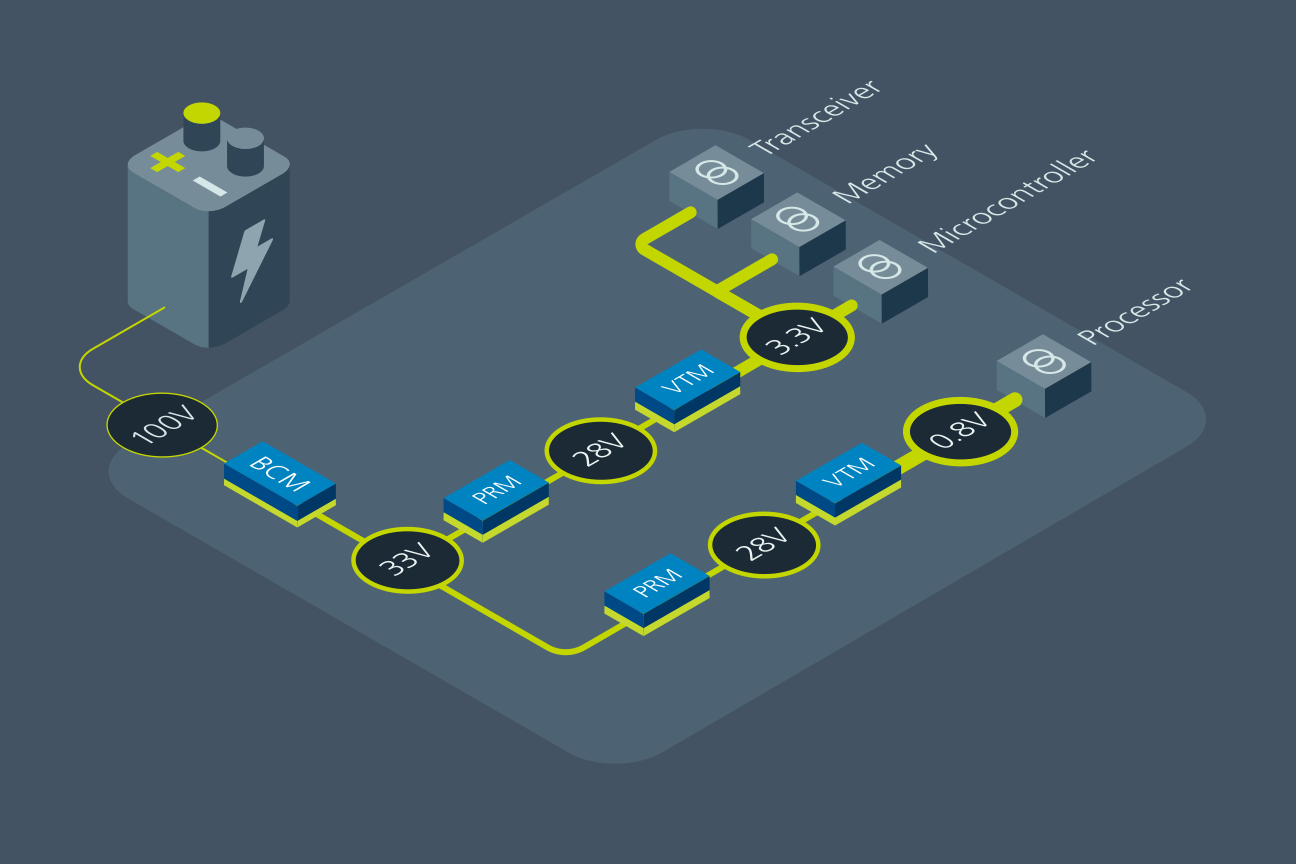
Figure 2: Vicor Factorized Power Architecture (FPA™) separates the functions of DC-DC conversion into independent modules. Using radiation-tolerant modules, the BCM® bus converter provides the isolation, the PRM™ regulator provides the regulation and the VTM™ current multiplier performs the DC transformation. This allows for better efficiency, flexibility and higher power density, especially in high-performance computing applications.
Bedi has incorporated Vicor FPA power modules into the Spacechips AI1 board. The Versal FPGA-based, reconfigurable, AI-enabled transponder allows telecommunications and SIGINT operators to perform real-time, on-board processing by autonomously changing RF frequency plans, channelization, modulation and communication standards based on live traffic needs. Vicor power converter modules also feature a dual powertrain, which for fault-intolerant space applications provides built-in redundancy that allows loads to be driven at 100 percent on each side of the powertrain.
“These advantages justified our decision to baseline Vicor FPA for Spacechips AI1,” Bedi said. “And because we’ve already derisked and designed-in a scalable power solution, we can move to even higher levels of power consumption without reinventing the wheel.”
Bedi said Spacechips will continue striving to increase processing power and flexibility to support the next generation of satellite missions. Bedi is driven by the opportunity, not only to solve emerging technical space problems, but to identify new applications that can better serve our world.
“Spacechips is still the world’s only dedicated space electronics company,” Bedi shared. “We’re part of a New Space Economy that is growing rapidly and poised to offer a lot of great value to a wide variety of markets. Many non-space companies are now capitalizing on space data to enhance the delivery of their products and services. It’s a new industrial revolution, and our products and services align with that opportunity.”
Together Spacechips and Vicor have partnered to design the most power dense processer board on orbit. The AI1 board is rad-tolerant, rugged and compact, setting a new standard for power processing and enabling the untold impact of computing for New Space. The innovative spirit and drive of Spacechips is changing our world from outer space to Earth.
This article was originally published by Power Electronics Europe.
Salah Ben Doua, Principle Applications Engineer, has 30 years of experience in the field of power design and has been supporting Vicor customers for over 20 years, providing expertise and advice in the development of dc-dc and ac-dc power systems in a multitude of areas, including aerospace and defense, industrial, rail, lighting and communications. Salah received a Ph.D. from the National Polytechnic Institute of Toulouse, specializing in power conversion.
Salah Ben Doua, Principle Applications Engineer
Arrow: Driving the future of industry in robotics, industrial IoT, and intelligent automation seminar 2026
Industry-leading power density and innovative architectures of Vicor power modules for robotics, industrial IoT, and intelligent automation
Digitimes key pathways for unmanned vehicle technology
Learn about high-density power conversion for UAVs
Accelerate your move to a high performance 48V power delivery network
This eBook provides guidance on designing 48V power delivery networks to enhance the performance, efficiency, and reliability of industrial products
Build better UAVs using modular power
Power Delivery Networks (PDN) based on Vicor high performance power modules enable innovative designs for the next generation of UAV development