
Arrow: Driving the future of industry in robotics, industrial IoT, and intelligent automation seminar 2026
Industry-leading power density and innovative architectures of Vicor power modules for robotics, industrial IoT, and intelligent automation


Discover how ReVolt is transforming film sets into sustainable DC microgrids. By leveraging high-density Vicor power modules, they’ve replaced noisy diesel generators with clean, 800V mobile power that cuts emissions and costs.
Europe’s push toward sustainability, combined with tightening emissions regulations, has created growing demand for alternatives to fossil fuel-based mobile power. Film commissions, municipalities, and construction firms are increasingly prioritizing low-carbon solutions, not only for environmental reasons but also for permitting, public perception, green certifications, and operational efficiency. Fastidious reporting is now required on emissions for film sets in many countries and funding or fines for non-forming levels can hang in the balance.
ReVolt offers an electrified mobile power platform that demonstrates a practical path forward – one that does not require sacrificing performance or reliability. ReVolt’s WeVolt and Mule systems were designed from the ground up with engineering rigor, rather than incremental improvements to combustion technology. Their approach reflects a seismic shift toward emission-free energy delivery systems that are vastly cleaner by design and would virtually ensure all industries could easily comply with emission standards. ReVolt would nearly eradicate non-conformance fines or penalties.
For decades, mobile power has relied on a simple but inefficient system using fossil fuel generators. Generators were transported to a site where they burn diesel fuel and users had to accept the emissions, noise, logistical challenges, and safety compromises that came with it. This approach has been common across many industries – from film and television production to construction and live events – not because it is optimal, but because suitable alternatives did not exist. Alternatives have lacked the power density, reliability, and operational flexibility required in the field, until now.
ReVolt is challenging that legacy model by reframing mobile power delivery around electrification rather than combustion. Instead of moving fuel and generators, ReVolt moves stored electrical energy directly to sites, using modular lithium-based battery platforms designed for professional, high-demand applications. The result is a cleaner, quieter, and more efficient approach to off-grid energy that aligns with Europe’s accelerating sustainability goals.
Traditional mobile power depends on a fuel-truck supply chain: diesel is transported, stored on site, burned in generators, and replenished continuously. This model introduces multiple inefficiencies, including fuel transport emissions and costs, idling losses and pollution, acoustic pollution, and significant operational overhead.
ReVolt replaces this paradigm with high-capacity lithium battery systems that are charged off-site – often from grid-connected, renewable, or hybrid energy sources – and then deployed as modular power units. Energy is delivered as electrons rather than fossil fuels that are chemically converted on site. This fundamental difference eliminates combustion entirely during operation drastically shrinking the carbon footprint. This shift is not simply a fuel substitution. It represents a structural change in how mobile power is engineered, deployed, and managed.
At the core of ReVolt’s system is a modular battery architecture built around lithium iron phosphate (LiFePO4) chemistry, selected for its thermal stability, long cycle life, and suitability for demanding duty cycles. These battery modules are integrated into ruggedized platforms capable of delivering consistent power outputs suitable for professional lighting (including HMI lighting), equipment, and infrastructure loads.
Power electronics play a critical role in enabling this architecture. High-efficiency inverters, advanced battery management systems (BMS), and redundant safety controls ensure stable voltage, predictable performance, and fault tolerance in dynamic environments. Intelligent charge management allows units to be rapidly recharged and redeployed, supporting continuous operation across multi-day or multi-week projects. ReVolt distinguishes itself with patented always-on technology that can recharge while continuing to power loads.
Unlike traditional generators that are sized for peak load and operate inefficiently at partial demand, battery systems deliver only the energy required, reducing waste and improving overall system efficiency.
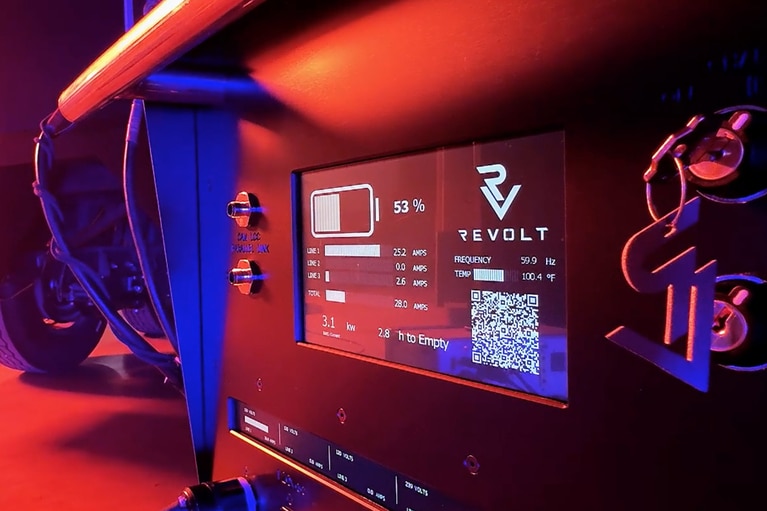
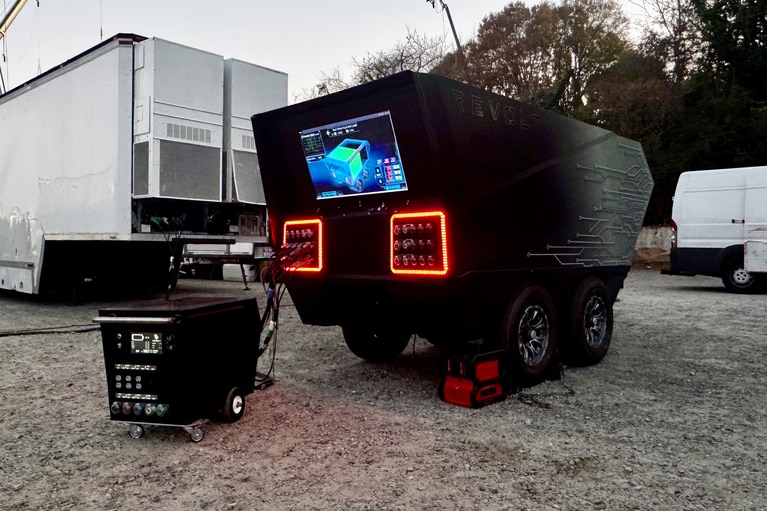
Figure 1: The WeVolt and Mule are two mobile power systems in the ReVolt fleet that are showing up on film sets and construction sites delivering power and drastically reducing the carbon footprint.
One of the key advantages of ReVolt’s approach is modularity. Rather than relying on a single centralized generator, power can be distributed across multiple battery units positioned closer to the point of use. This reduces cable runs, simplifies site layouts, and improves redundancy.
In film and television production for example, this allows power to be placed directly at lighting clusters, interior sets, or remote locations without the need for large generators parked curbside. In construction environments, modular battery platforms can support cranes, hoists, and temporary site infrastructure while reducing noise and emissions in dense urban areas. Live events benefit from silent operation and reduced acoustic interference, particularly in noise-sensitive venues.
This distributed architecture also enhances safety by minimizing fuel storage on site and reducing exposure to high-temperature exhaust systems.
The most immediate benefit of electrified mobile power is the elimination of on-site emissions. By removing combustion from the point of use, ReVolt systems produce zero local exhaust, contributing to improved air quality and reduced carbon footprints. Depending on charging sources and duty cycles, overall emissions reductions can be substantial compared to diesel-based systems.
Noise reduction is equally significant. Battery systems operate silently relative to generators, transforming working conditions for crews and surrounding communities. In film production, this noise reduction directly improves sound recording quality and reduces the need for acoustic mitigation. In construction and live events, it supports compliance with increasingly strict noise regulations across Europe.
“The big thing is we're not pumping out toxic fumes,” said JD Schwalm, CEO of ReVolt. “You can run our systems on interior film sets with no concern. The cool thing about our unit is we deliver pure sinewave AC power to audio recording equipment achieving excellent clarity."
These benefits align closely with European initiatives aimed at decarbonizing temporary energy use, particularly in urban environments where emissions and noise are under heightened scrutiny.
Electrifying mobile power introduces new engineering challenges, particularly around high-voltage safety, thermal management, and regulatory compliance. ReVolt addresses these through layered safety systems, including active monitoring, fault isolation, and compliance with applicable electrical and transport standards.
Battery enclosures are designed for durability and environmental protection, while control systems continuously monitor temperature, voltage, and load conditions. This approach enables safe operation across varied climates and use cases, from outdoor festivals to enclosed interior sets.
Importantly, the transition to electrified mobile power also simplifies compliance in many jurisdictions by removing fuel handling, spill risk, and exhaust management from the equation. ReVolt has designed patented power technology into an expanding fleet of portable vehicles.
The smallest power system, the WeVolt, generates 14kW of output power and has an overall 17.5kWh energy capacity, while the 8,500-pound Mule delivers 120kW of output power and has a total energy capacity of 210kWh, supplying on-demand energy across 480, 208, 240, and 110 connections. Additionally, this technology is virtually silent, emitting about as much noise as a computer fan.
Since mobility was a key feature of the ReVolt business model, careful consideration was given to components used in the system design. Vicor modular power converters are essential to delivering highly efficient power conversion and mobility because of their power density and small size.
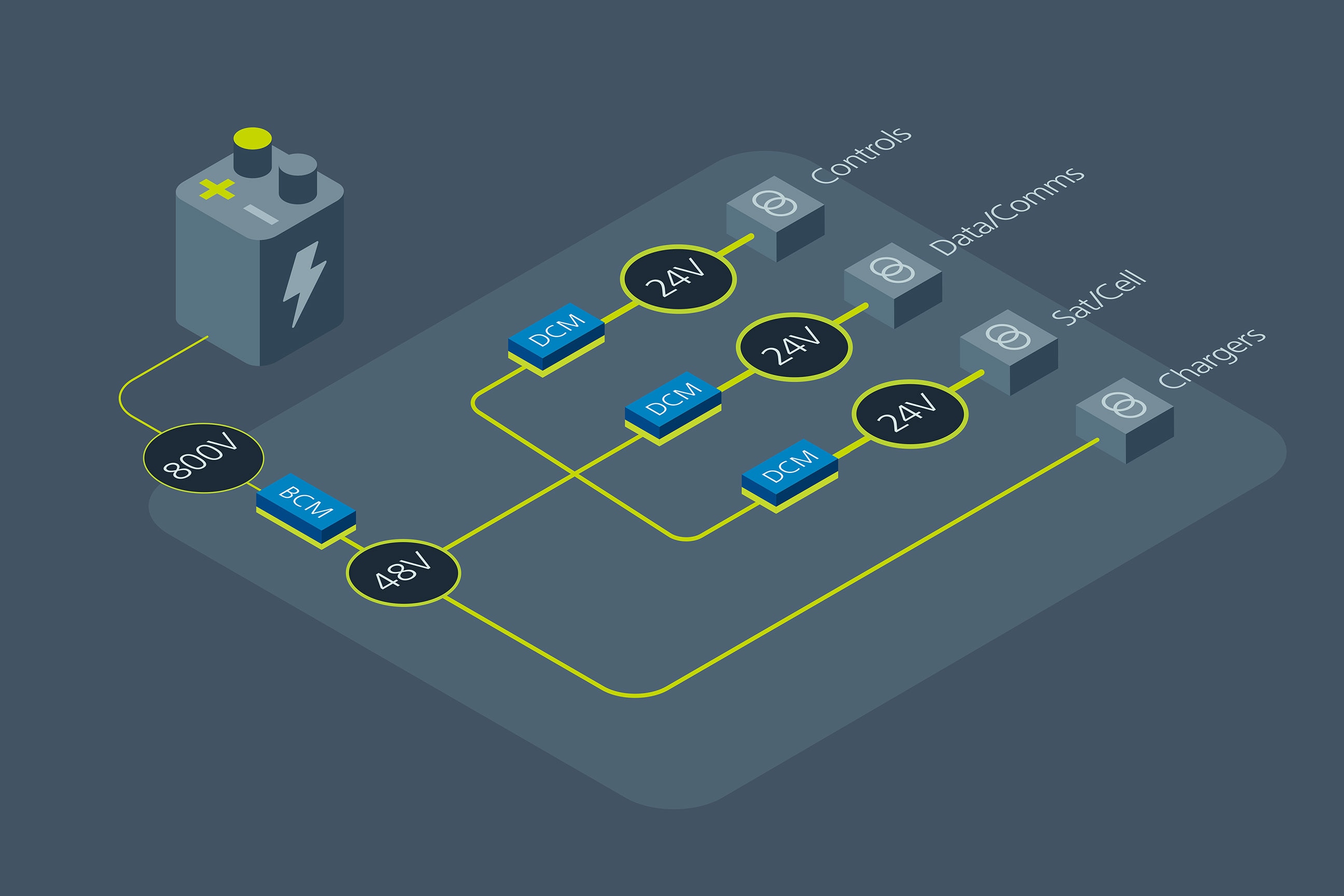
Figure 2: The BCM4414 converts and isolates 800V into a 48V bus at 35A, which the DCM3414 taps off to regulate 24V loads. The BCM4414 also serves as a battery emulator, reducing the need for a bulky 48V battery.
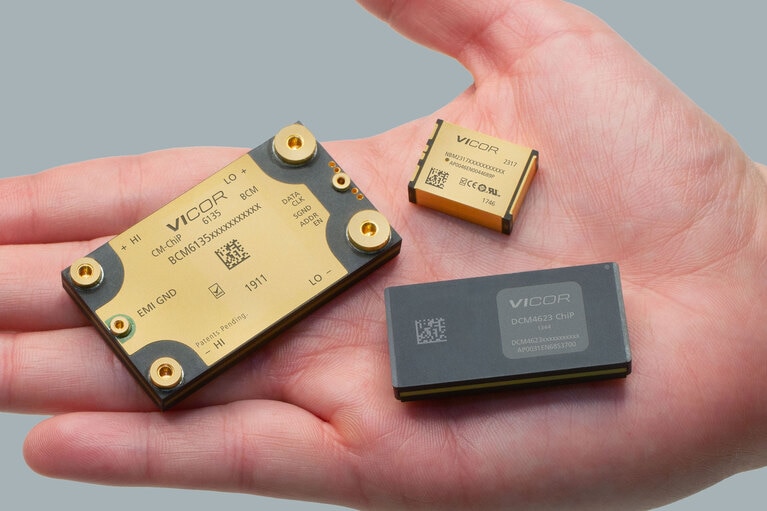
To enable mobility and high performance, power density is needed. ReVolt chose the Vicor BCM® fixed ratio bus converters and DCM™ DC-DC converters. The Mule uses a BCM4414 to convert and isolate an 800V battery, making a 48V bus. An array of DCM3414s convert and regulate the 48V bus for various 24V loads. The high power density (770W/in3) BCM4414 has extremely fast transient response, which eliminates the need for a bulky intermediate 48V battery. “With one Vicor module, we can do what it would take eight components to achieve,” Schwalm said.
Ultimately, ReVolt’s innovation lies in treating mobile power as an energy infrastructure problem rather than an equipment problem. By decoupling power delivery from fuel combustion, the company is helping to redefine how temporary energy systems are designed, deployed, and scaled.
As industries across Europe continue to electrify, from transportation to construction, the same principles are increasingly being applied to off-grid power. ReVolt’s battery-based platforms demonstrate that electrification is not only viable in mobile applications but often superior.
Europe envisions a future with reduced emissions, a cleaner environment, and healthier communities. ReVolt has designed power technology that is quieter, cleaner, more efficient, and most importantly, electric and renewable. ReVolt is the future of high-performance mobile power, and it can help Europe achieve the better, greener world it envisions.
This article was originally published by Electronic Specifier.
Arrow: Driving the future of industry in robotics, industrial IoT, and intelligent automation seminar 2026
Industry-leading power density and innovative architectures of Vicor power modules for robotics, industrial IoT, and intelligent automation
Microgate’s out-of-this-world mission requires precision power
Microgate and Vicor power the world's largest telescope! Vicor’s modules deliver 10kW to 5400 actuators, helping Microgate eliminate space image distortion
Revolt is tackling the film industry’s dirtiest production secret - CO2 emissions
ReVolt Fuel tackles the film industry emitting 700k tons of CO2 per year to deliver clean on-set electricity with help of Vicor power modules
11 ways to fine tune your high-voltage-to-48V power conversion
Converting high-voltage to 48V DC slashes cabling costs and weight, significantly boosting energy efficiency across data centers and industrial systems.