


Open-standard VPX is gaining momentum in the US, Europe, and beyond
Since 2010, the Sensor Open Systems Architecture (SOSA) standards have helped the US Military to thrive. Learn how Vicor can offer more in this new space


Discover why the rapid global adoption of VITA and SOSA open standards is transforming defense electronics, and learn how to choose the right power supply in an increasingly crowded market. Dan Morgan, President of Freedom Power (a Vicor company) breaks down critical evaluation factors—from "qualified to" vs. "designed to meet" certifications to internal modular architecture and power density headroom. Read the full article to find out how to future-proof your airborne, ground vehicle, or electronic warfare systems as next-generation payloads advance.
By Dan Morgan, President of Freedom Power, a Vicor Company
Since 2010, the VITA (OpenVPX) and the Sensor Open Systems Architecture (SOSA) standards have been a strategic boon for U.S. defense. By standardizing form factors, backplane interfaces, and power rails for rack-based embedded computing, these architectures have opened the defense electronics supply chain to multi-vendor competition for the first time.
Now, what began as a U.S. program initiative is gaining traction well beyond American borders. Today, European defense primes, allied nations, and global contractors worldwide all specify 3U and 6U VPX power cards for airborne, ground vehicle, and electronic warfare systems, using the U.S.-developed SOSA baseline as their starting point. And, the supplier ecosystem has grown to match, with multiple vendors now offering SOSA-aligned power cards that drop into any chassis.
With so many vendors offering interoperable solutions, it can be hard for designers to know which product best fits their given design requirements. To make better, more informed defense electronics decisions, designers need to first understand which specifications to look for and what trade-offs will be acceptable.
Prior to VITA and SOSA, defense electronics historically relied on bespoke, single-vendor designs. In these instances, engineers built each program’s power subsystem to that platform’s specific requirements, sourced it from a single supplier, and qualified it once. While that arrangement provided predictability, the acute specificity hindered competition.
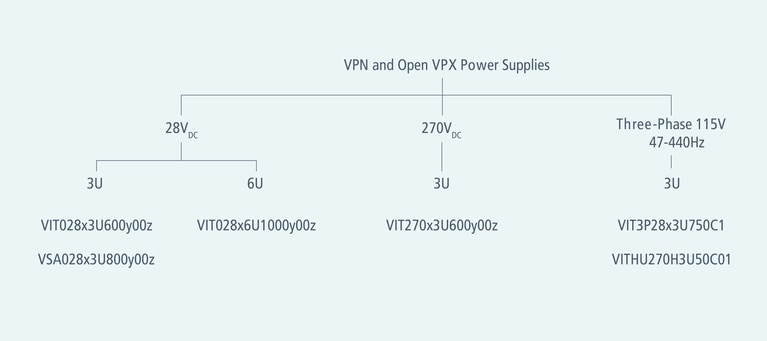
The U.S. developed VITA and SOSA to change that narrative through standardization (Figure 1). Specifically, these architectures standardize form factors, backplane pinouts, and power interfaces to enable inter-vendor interoperability between otherwise disparate defense systems. For example, a SOSA-aligned VPX power card accepts 28 or 270V input and delivers a 12V high-current output with a 3.3V auxiliary rail, packaged in a 3U or 6U form factor for any chassis. In that way, defense designers get the confidence and security they need, knowing that any two vendors’ cards will slot into the same backplane and output the same voltages.
But even though standardization guarantees conformity with respect to form factor, input, and output, not all solutions are equal. In reality, many other considerations – such as internal topology, qualification rigor, power-density headroom, and supplier reliability – should all factor into a designer’s choice of VITA and SOSA-aligned solutions.
Figure 1: Vicor VITA 62 and SOSA power supplies classified by input voltages – a system of standardization that has enabled multi-vendor competition.
Standards such as MIL-STD-461, MIL-STD-1275, and MIL-STD-704 set electrical requirements for defense power electronics. And while nearly every VPX power card datasheet references these standards, suppliers normally designate their solutions as either “designed to meet” or “qualified to” a given standard.
A “designed to meet” means the standards are the target, but the designers have not necessarily completed testing or formally documented results. For instance, a card labelled
“designed to meet MIL-STD-461” has not necessarily passed EMC testing.
“Qualified to”, on the other hand, means the designers have run the product through the full test regimen and hold documented results. Designers know for certain that a card qualified to MIL-STD-461 has completed testing with traceable, accessible data to prove it.
The difference matters because discovering compliance failures during system integration testing can derail schedules and budgets. “Qualified to” solutions give designers much higher confidence in success and compliance, whereas “designed to” solutions are more likely to require late-stage redesigns that restart full qualification campaigns, which can take months and cost millions.
This difference is even more pronounced in Europe, where defense customers routinely request compliance documentation before contract award. A supplier that can provide complete qualification test reports on first request can shorten the evaluation cycle and remove a source of program risk before the program begins.
At the highest level, SOSA specifies the power card’s output interface (i.e., the voltages delivered, the connector pinout, and the form factor). But the standard says nothing about how the card generates that output. Two cards that both satisfy the SOSA power interface specification can be built around entirely different internal architectures, with very different implications for program flexibility.
For example, a card built around discrete, hard-switched converters is likely one optimized for a single design point. The designers have already tuned the magnetic components, switching network, and control loop to specific input and output conditions. Any request for non-standard auxiliary voltages, split rails, or unusual transient profiles would then require a full board redesign, which in turn restarts the entire qualification process.
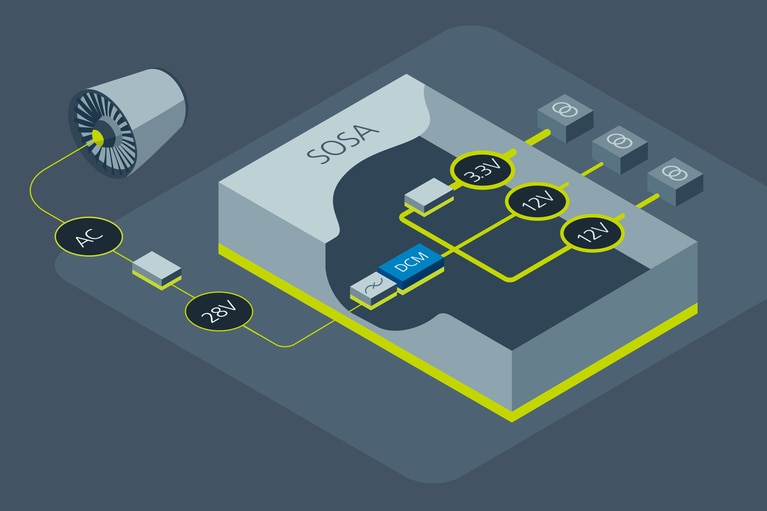
In contrast, with a card built on modular DC-DC converters, designers can handle non-standard outputs by simply reconfiguring or swapping internal modules as shown in Figure 2. In such a situation, they can keep the front-end compliance circuitry, EMI filtering, and primary conversion stage identical while only changing the output stage. As a result, only the output stage would require re-evaluation, while the rest of the card can carry forward. Comparatively, this approach yields a significantly more flexible design that, in turn, can save organizations significant time and money later on.
Figure 2: A design based on modular components can be easily adapted to suit late-stage changes or to design a family of products that require just modest powered adjustments.
This consideration is particularly pertinent to European defense programs, as they frequently deviate from the U.S.-developed SOSA baseline. By choosing qualified solutions with modular designs, European designers can easily serve a wide range of allied-nation programs and applications, each with different output requirements, without a full qualification restart.
While the VPX form factor is fixed, the power a card can deliver in that envelope does not have to be.
Today, programs typically specify 28V input cards delivering around 800W in a single 3U slot. However, next-generation electronic warfare, directed-energy, and AI-at-the-edge payloads are already pushing requirements toward 1kW and beyond within the same form factor. A supplier whose card is already at the ceiling of its internal topology has no upgrade path within the slot, and meeting the higher power requirement would mean a new board design, a new qualification campaign, and a new chassis integration effort. Those costs quickly multiply when applied across an entire program family.
Instead, designers should work with suppliers whose internal modules continue to improve in power density. For example, a supplier using modular, evolving DC-DC converter technology can increase card output as modules advance, without changing the board footprint or triggering a new chassis qualification. Power density headroom also frees adjacent slots. A 3U power card that delivers more output per slot leaves room for additional payload cards, expanding system capabilities without requiring a larger chassis.
For those reasons, engineers evaluating power card suppliers should ask about the supplier’s internal module roadmap.
SOSA’s competitive ecosystem delivers value only if its suppliers can meet program volumes even as they scale.
Consider that a single-platform production contract can require tens of thousands of units per year, and that a multi-platform award could extend that across multiple production lines for decades. Keeping the program running for that long and at that scale requires a supplier that can genuinely demonstrate a stable supply chain, manufacturing capacity, and financial continuity.
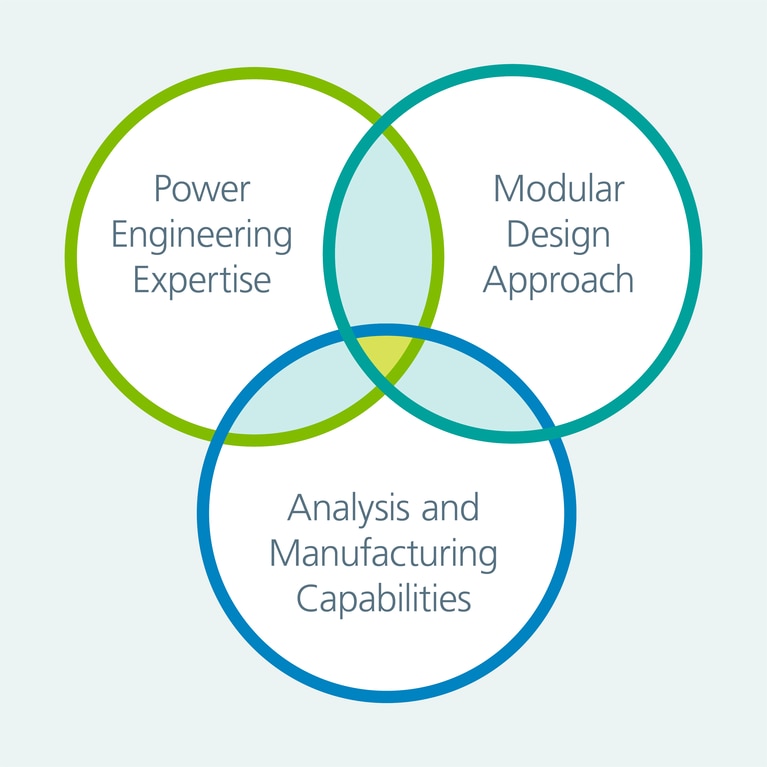
Vertically integrated suppliers are significantly better suited to meet such demands, as shown in Figure 3. For example, a supplier that manufactures its DC-DC converter modules at its own facilities controls the most important elements of its bill of materials without relying on external vendors. Such a supplier can plan its own production directly, without an intermediate tier to absorb or amplify supply chain disruptions.
A supplier that sells those modules to other VPX card developers also has real-time upstream visibility into the supply chain. Should allocation pressure build across the defense electronics supply chain, a manufacturer that sits at the top of its own supply chain can prioritize its own card programs and respond to disruptions faster than a supplier that sources components externally.
For European buyers evaluating a U.S.-based supplier for the first time, financial stability and manufacturing depth should carry as much weight as the technical specification. A power card that performs well in qualification but comes from a supplier who can’t scale with the program is not a long-term solution.
Figure 3: The ideal supplier has a unique combination of engineering expertise, modular design approach, and vertical integration.
Freedom Power, a Vicor company, produces 3U and 6U VPX power cards that meet many of these challenges. Built on Vicor’s DCM™ and BCM® converter modules, Freedom Power’s cards:
As NATO allies and European primes adopt VPX-based open architectures, backplane hardware interoperability has become a baseline expectation. But while every card meets the interface requirement, deeper considerations like qualification depth, architectural flexibility, and supply chain stability will ultimately determine a system’s long-term success.
By working with suppliers like Freedom Power and Vicor, defense engineers can design defense electronics that meet today’s requirements and scale with the program as payloads advance or geographies expand. Want to learn more? Check out Vicor’s lineup of SOSA-aligned power supplies.
This article was originally published by Components in Electronics.
Dan Morgan is the President of Freedom Power Systems, Inc., a Vicor Company. With over 29 years of experience in power supply design and manufacturing, he is responsible for global power engineering, product development, and defense-market (MIL-COTS) solutions. Dan received his Bachelor of Science in Physics and Electrical Engineering Technology from the Southern College of Technology (now Kennesaw State University) in 1995, and his Master of Science in Engineering from the University of Texas in 2006.
Dan Morgan, President of Freedom Power, a Vicor Company
Open-standard VPX is gaining momentum in the US, Europe, and beyond
Since 2010, the Sensor Open Systems Architecture (SOSA) standards have helped the US Military to thrive. Learn how Vicor can offer more in this new space
Achieving seamless interoperability and long-term upgradeability
Understand which specifications to look for and what tradeoffs will be acceptable, to choose products that best fit your design requirements
Quickly modifying a standard SOSA supply to meet an applications hold-up requirements for vehicle protection and countermeasures
Learn how Vicor delivers power to vehicle protection and countermeasures systems using a configured SOSA aligned power supply
Adjusting one of the VITA supply voltage outputs easily and quickly for ground mobile radar
Learn how Vicor delivers power to ground mobile radar using time- and cost-effective Vicor VPX solutions