Current gain and current density essential to power AI today: Patrizio Vinciarelli interview
Patrizio Vinciarelli, CEO of Vicor shares insights on powering AI today and its extraordinary current demands and the need to easily scale


Finding an efficient, compact solution to meeting EMI requirements is a greater challenge than ever.
In the USA and Europe, conducted noise emissions are governed by the Class A and Class B limits of both FCC and VDE standards. In the USA, the FCC requires compliance with Class A for equipment operating in factory settings and Class B—the stricter standard—for equipment destined for home use. In Europe, all countries require that equipment for both home and factory use meet the VDE Class B standard.
The FCC and VDE standards are familiar worldwide and the basis for many local standards. Meeting FCC/VDE Class B limits allows equipment to be operated in most settings anywhere.
“Conducted noise” refers to noise currents on the input power lines which are generated by high frequency switching circuits within equipment connected to the lines. These noise currents, which include common-mode and normal-mode noise, flow between the power source and the equipment power supply and find their way back onto the power lines. Common-mode conducted noise current is the unidirectional (in phase) component in each of the two power lines, which generally finds a return path via the third (earth ground) wire. Normal-mode conducted noise current is the component of current which is opposite in direction or phase in the two power lines.
Conducted noise measurements may be made using either a receiver or a spectrum analyzer in conjunction with related equipment to obtain sufficient sensitivity and overload protection to ensure accurate, repeatable measurements of all emissions over the frequency range of 100kHz to 30MHz. Both the equipment under test (EUT) and the receiver or analyzer are connected to the power source through a line impedance stabilization network (LISN).
The LISN provides power line frequency (50 – 60Hz) coupling between the EUT and the power source, while ensuring a high degree of isolation over the spectral measurement range. The receiver or analyzer provides a 50 ohm termination to the LISN measurement port. This guarantees a fixed or calibrated relationship between conducted EMI current and the resulting voltage at the input of the measurement apparatus.
Related content
Webinar: EMI characterization and filtering
Current gain and current density essential to power AI today: Patrizio Vinciarelli interview
Patrizio Vinciarelli, CEO of Vicor shares insights on powering AI today and its extraordinary current demands and the need to easily scale
Revolt is tackling the film industry’s dirtiest production secret - CO2 emissions
ReVolt Fuel tackles the film industry emitting 700k tons of CO2 per year to deliver clean on-set electricity with help of Vicor power modules
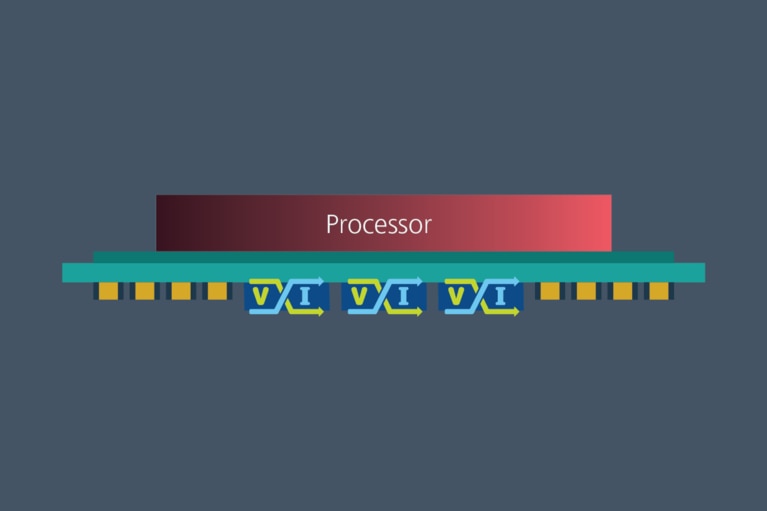
Powering AI Processors using a 48V Factorized Power Architecture™
Using a 48V Factorized Power Architecture™ to overcome traditional multiphase limitations and drastically cut I²R thermal losses for high-demand loads
11 ways to fine tune your high-voltage-to-48V power conversion
Converting high-voltage to 48V DC slashes cabling costs and weight, significantly boosting energy efficiency across data centers and industrial systems