
Arrow: Driving the future of industry in robotics, industrial IoT, and intelligent automation seminar 2026
Industry-leading power density and innovative architectures of Vicor power modules for robotics, industrial IoT, and intelligent automation



Fit into a small housing

Remain close to ambient temperature

Precise power
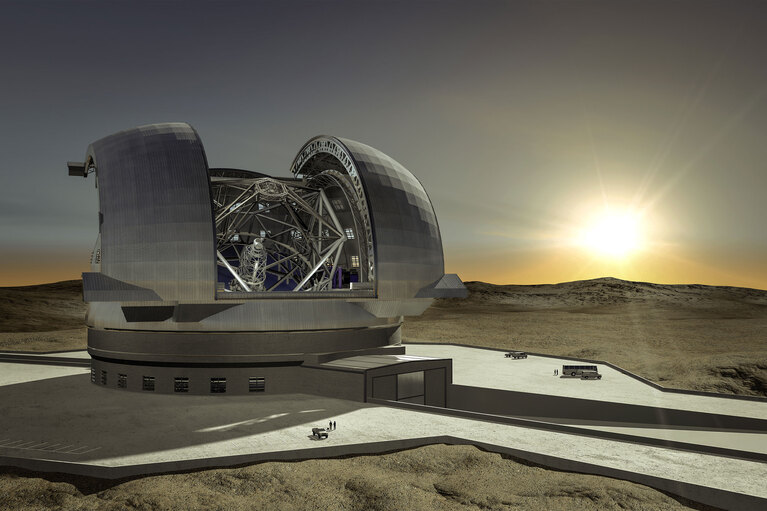
Microgate, established in 1989 and located in Bolzano Italy, designs linear motor-drive control systems for Extremely Large Telescopes (ELTs), which are the biggest telescope installations on the planet. Used for deep space exploration, ELT’s require highly sophisticated automated optics to capture the weakest light arriving from trillions of miles away to produce high resolution images. Atmospheric disturbances known as a wave-front aberration, degrade light sources and distort imagery, and require a delicate process to re-align and remove these aberrations.
Power dense

Lightweight

Thermally adept
Microgate has developed an innovative adaptive optics technology that overcomes the complex wave-front aberration challenge. The system consists of a primary mirror that reflects captured light to a secondary adaptive mirror, which physically deforms the light to re-establish what is known as a “plane” wave-front. Deforming the mirror to manipulate the incoming wave-front is achieved using sophisticated contactless linear motors. These motors, correct for atmospheric disturbances and enhance images.
The adaptive mirror of the European Extremely Large Telescope (E- ELT)is 2.4 meters in diameter and is made of specialized glass, 1.9 millimeters thick. Linear motors are powered by a precise current driver and a series of co-located permanent magnets. These are attached to the back of the mirror and provide the force to deform the glass. This process is performed across the entire surface of the adaptive optics using 5,316 motors, each with an inter-axis distance, or pitch, of about 30 millimeters.
Precise manipulation and thermal management of the adaptive optics system is critical and requires all exposed surfaces to be kept close to ambient temperature to avoid local turbulence.
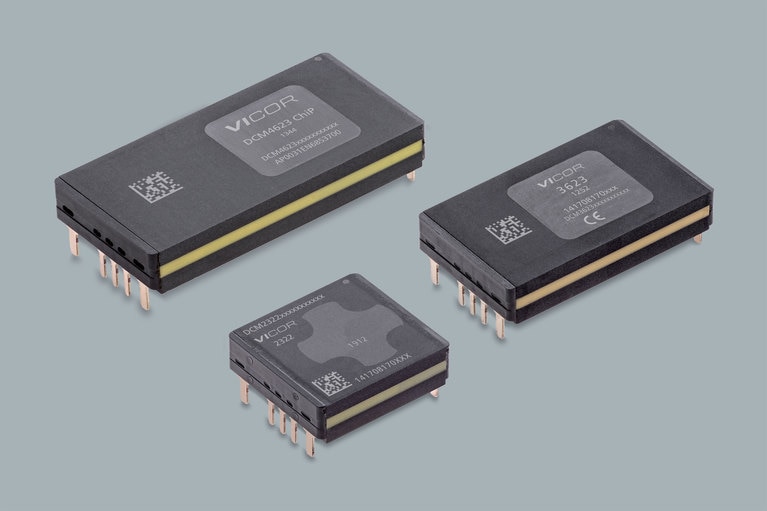
The Vicor DCM3623 series of DC-DC converter powers the linear motors in the adaptive mirror. The power system board is mounted on the underside of the gas-cooled cold plate, and each module powers up to 36 motors, eliminating complex wiring.

The Microgate power delivery network uses the Vicor DCM3623 to deform the secondary lens. The voice-coil motors are powered by a precise current driver and a series of co-located permanent magnets that provide the force to deform the glass. This process is performed across the adaptive optics lens using 5,316 motors. The Vicor DCM3623 DC-DC converters can power up to 36 motors channels at one time.
The Microgate power delivery network uses the Vicor DCM3623 to deform the secondary lens. The voice-coil motors are powered by a precise current driver and a series of co-located permanent magnets that provide the force to deform the glass. This process is performed across the adaptive optics lens using 5,316 motors. The Vicor DCM3623 DC-DC converters can power up to 36 motors channels at one time.
Isolated regulated
Input: 9 – 420V
Output: 3.3, 5, 12, 13.8, 15, 24, 28, 36, 48V
Power: Up to 1300W
Peak efficiency: 96%
As small as 24.8 x 22.8 x 7.21mm
Arrow: Driving the future of industry in robotics, industrial IoT, and intelligent automation seminar 2026
Industry-leading power density and innovative architectures of Vicor power modules for robotics, industrial IoT, and intelligent automation
INFAC bolsters EV range by packing more power into the battery pack
INFAC integrates the DC-DC converter into EV battery pack to leverage cooling system and save space. 48V power dense modules help downsize cable and connectors to boost range.
Microgate’s out-of-this-world mission requires precision power
Microgate and Vicor power the world's largest telescope! Vicor’s modules deliver 10kW to 5400 actuators, helping Microgate eliminate space image distortion
Revolt is tackling the film industry’s dirtiest production secret - CO2 emissions
ReVolt Fuel tackles the film industry emitting 700k tons of CO2 per year to deliver clean on-set electricity with help of Vicor power modules