Current gain and current density essential to power AI today: Patrizio Vinciarelli interview
Patrizio Vinciarelli, CEO of Vicor shares insights on powering AI today and its extraordinary current demands and the need to easily scale
Founded by a former CERN physicist, Patrizio Vinciarelli, CEO and Founder of Vicor which pioneered Vertical Power Delivery to overcome the severe current density bottlenecks facing modern AI processors. By routing power directly through the underside of the chip rather than laterally, this architecture minimizes voltage loss and thermal resistance. As industry leaders like Google, NVIDIA, and AMD transition to vertical power, Vicor's second-generation design provides the scalable current density required for next-gen data centers.
Vicor Corporation is a power technology company that develops high-performance power modules and power delivery solutions that enable efficient power conversion for AI processors, data centers, aerospace, industrial, automotive, and other high-performance computing applications.
Q: You founded Vicor more than 40 years ago after beginning your career as a physicist. Could you take us back to the company's origins and explain the problem you set out to solve?
A: At the time, I was a physicist working at CERN in Switzerland. Outside of physics, I had a passion for classical music, and when the power supply in my audio amplifier failed, I looked inside and was struck by how primitive the design seemed. That sparked my curiosity about power conversion, although it wasn't until nearly a decade later, while I was at Princeton University, that I began seriously exploring better ways to process power.
That curiosity ultimately led me to leave physics and found Vicor in 1981 with the support of several fellow physicists who helped finance the business. From the beginning, the goal was to rethink power delivery and create more efficient, higher-performance power systems—an ambition that continues to define the company today.
Q: Much of the conversation around AI infrastructure focuses on chips and models. Why has power delivery become such a critical part of the equation?
"AI ultimately runs on electrical current. Processors operate at very low voltages but require increasingly high current densities, and delivering that power efficiently has become one of the biggest constraints on AI performance."
Put simply, if you can deliver more current within the same physical space, you can significantly increase computing capability while making better use of the limited space available inside data centers.
Power density has always been at the heart of Vicor's technology. Decades ago the challenge centered on power; today it's centered on current density. Modern AI processors require enormous amounts of current delivered with precision, and overcoming that challenge has become fundamental to enabling the next generation of high-performance computing.
Q: Vicor has pioneered vertical power delivery. Could you explain what that technology is and why it represents such a significant shift?
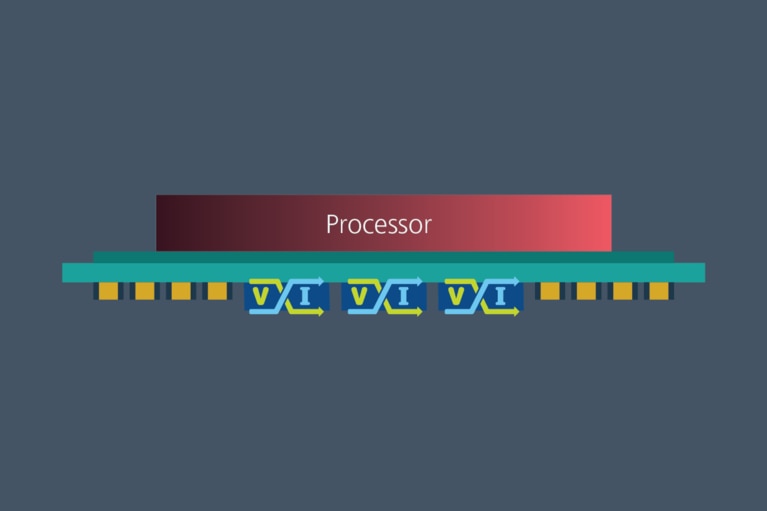
A: Vertical power delivery is already a commercial technology and has become essential for some of the world's most advanced AI processors. Traditional processors receive power laterally from the edges of the chip, but as processors become larger and more powerful, that approach becomes increasingly inefficient because electrical resistance causes unacceptable voltage losses.
Vertical power delivery instead brings power directly through the underside of the processor while heat is removed from the opposite side using advanced cooling. That requires an entirely new electrical, mechanical, and thermal architecture, but it enables the current densities that modern AI processors increasingly demand. Without that shift, many of tomorrow's highest-performance processors simply couldn't operate efficiently.
Q: Vertical power delivery is gaining momentum across the AI industry. How do you see adoption evolving, and what role will Vicor play in the next phase of that transition?
A: The industry has largely crossed the point of recognizing that this transition is necessary. Cerebras Systems adopted the technology first, followed by Google, which has deployed millions of processors using vertical power delivery. Increasingly, hyperscalers and semiconductor companies—including organizations such as NVIDIA, AMD, Amazon, and Meta—are moving in the same direction because the compute requirements of AI leave few practical alternatives.
At the same time, the technology continues to evolve. We pioneered the first generation of vertical power delivery, but we've since developed a second-generation architecture that addresses many of the electrical, thermal, and mechanical limitations of the original approach. Rather than simply moving power from the bottom of the processor, it fundamentally improves current density, reduces heat, and creates a more scalable, reliable, and cost-effective solution for future AI systems.
Q: How prepared is Vicor to meet the growing demand for your power conversion technology, and what impact could widespread adoption of vertical power delivery have on AI infrastructure?
A: Moving from conventional lateral power delivery to an advanced second-generation vertical power delivery system can reduce total power consumption by as much as 15%. Given that power availability is now one of the biggest constraints on scaling AI infrastructure, that level of efficiency has significant implications—not only for operating costs but also for enabling more AI compute within existing data center power budgets.
From a manufacturing standpoint, we're well positioned to support near-term demand through our existing foundry, which has substantial production capacity. At the same time, we're planning a second foundry to support future growth, although that will take longer to bring online. Until then, we'll continue prioritizing the applications and customers where our next-generation technology can deliver the greatest value.
This article was originally published by Investment Reports.
Current gain and current density essential to power AI today: Patrizio Vinciarelli interview
Patrizio Vinciarelli, CEO of Vicor shares insights on powering AI today and its extraordinary current demands and the need to easily scale
采用 48V 分比式电源架构™为 AI 处理器供电
采用 48V 分比式电源架构™ 克服传统的多相方案限制,显著降低了高需求负载下的 I²R 热损耗
以 48V 为 AI 处理器供电,向正确方向迈进
随着对人工智能处理器性能的需求激增,所有人都在寻求为其供电的最佳方法。答案比你想象的要简单——只需观察 2R
电流倍增器:为 AI 处理器及其他严苛应用供电的明智之选
AI 处理器需要解决低电压、高电流的严苛挑战,这将会导致电源系统设计产生瓶颈。了解 Vicor 的电流倍增技术如何改变这一现状。