Betterfrost: Putting on the heat
Betterfrost uses a 48V module for pulsed, conductive glass heating, clearing ice in under 60 seconds while cutting start-up defrost energy by 95%


By targeting only the microscopic layer where ice bonds to glass, BetterFrost has revolutionized vehicle de-icing. Backed by high-power Vicor converters, this pulsed-power innovation clears windshields in under 80 seconds. Discover how this software-driven breakthrough slashes energy consumption by 95% to solve a critical EV range challenge.
One of my favorite things about this job is hearing how the products that I write about are used in the real world. Normally these are in popular applications, such as data centers and EV powertrains, but occasionally one pops up that is totally unique. Recently, I talked to Vicor, and its customer, BetterFrost, about one such application.
We take many things for granted, and never try think of a better way of achieving them. Tasks like de-icing wind shields. A hot air blower, often in combination with heating elements in the glass, does a decent job, and that technique has been used for many decades, but could that be improved?
BetterFrost was founded specifically to answer that question. The company’s CEO, Derrick Redding explains, “internal combustion engines used to have plenty of waste heat. It's still inefficient to flood a surface with heat, even if you posses an almost unlimited supply. EVs don’t have that natural heat source, and today’s hybrid and ICE engines are getting so efficient they can't generate enough waste heat, so they're having to use secondary heaters.”
He continues, “our technology came from the ice lab at Dartmouth College of Engineering. One physicist there studied the way ice bonds on the surfaces and the best way to release it, using the least amount of energy. His key insight was to only melt the 0.1mm think interfacial layer, and then the ice will release. The most efficient way to achieve that is to pulse power to control how heat penetrates the surface and goes no farther than that interfacial lair.”
To achieve this, BetterFrost uses the transparent conductive oxide layer that is already integrated into the screen to provide infrared-reflecting properties. Unlike the resistance wires in a rear screen, the film is invisible and heats the whole surface evenly. The layer is heated using high power pulses, which confines the heat to the interfacial layer. This is impossible to achieve at lower power levels. The frequency of the waveform shifts continuously as the surface warms, and it must be precise enough not to crack the glass. The voltage used can vary from 48V up to the battery voltage.
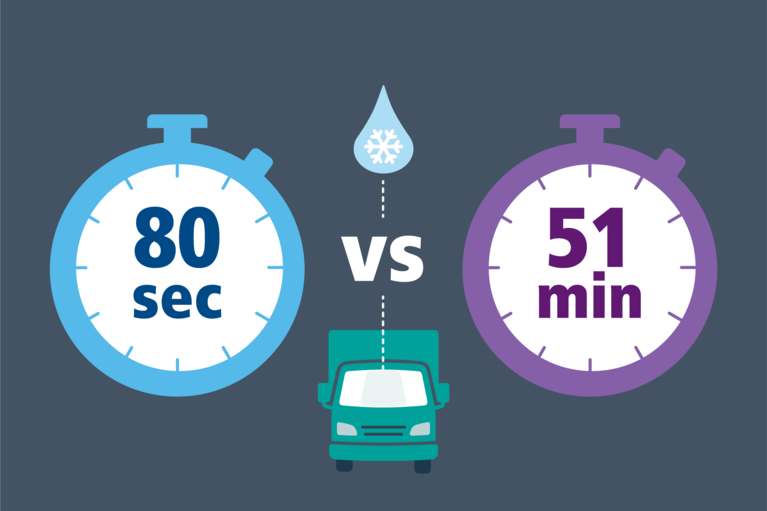
Testing has shown that measured against the FMVSS 103 defrost standard, the system uses 95–96% less energy than conventional air defrost, and 98–99% in commercial vehicles. An Alaskan test cleared a two-square-meter wind shield in 80 seconds, while the truck's own air defrost took 51 minutes. The same technique can also be used for demisting on the move. This is important for EVs that fog up far more readily than ICE vehicles.
BetterFrost was assisted by Vicor in getting the design up and running. Current is supplied through bus bars and connected in the same way as resistive heating. A compact Vicor step-down converter feeds the bus bars. BetterFrosts main contribution is the software that controls the pulses, along with assisting OEMs through specification, prototyping and validation.
This article was originally published by Power Systems Design.
Betterfrost: Putting on the heat
Betterfrost uses a 48V module for pulsed, conductive glass heating, clearing ice in under 60 seconds while cutting start-up defrost energy by 95%
Betterfrost harnesses 48V in EVs for record-setting windshield defrosting and to extend winter range
Betterfrost’s 48V power control module uses conductive pulsed heating to defrost EV glass in under 60 seconds, saving energy and preserving winter range
因派克(INFAC)为电池组提供更多电力,增加电动汽车续航里程
INFAC 将 DC-DC 转换器集成到电动汽车电池组中,利用冷却系统并节省空间。48V 高功率模块有助于减小电缆和连接器尺寸,进而提升里程范围
2026 年汽车创新日
Vicor 展示了使用紧凑、高功率密度的 DC-DC 转换的创新优势