

INFAC enables 48V automotive zonal architectures using Vicor high density power conversion technology.
INFAC enables 48V automotive zonal architectures using Vicor high density power conversion technology
INFAC boosts range by integrating DC-DC conversion into EV battery pack
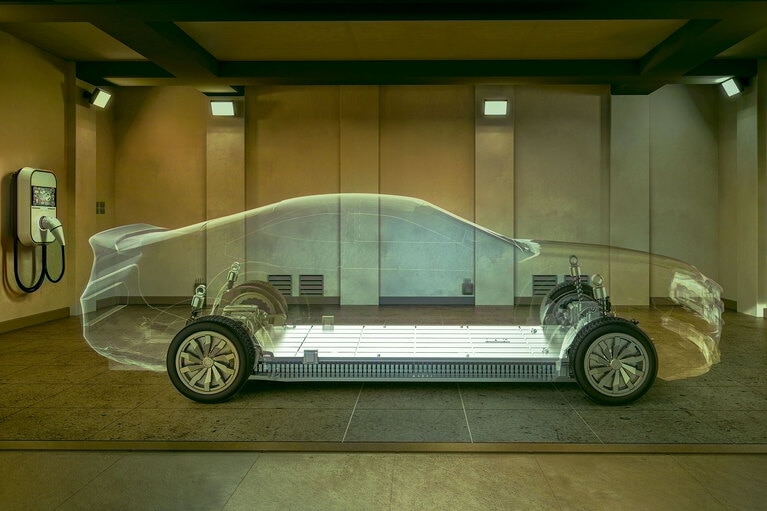


South Korea’s INFAC Corporation has introduced an innovative 800V battery pack design block for electric vehicles that integrates a high-power 800V-to-48V isolated and regulated DC-DC converter. The new design improves vehicle performance, power efficiency and boosts range through the reduction of high-voltage cables and connectors.
Rather than treating the DC-DC conversion stage as a distributed standalone subsystem, INFAC designed the power to be stepped down at the source for SELV distribution throughout the vehicle. That streamlined approach enables cleaner, flexible, more modular 48V zonal designs for various EV platforms without displacing battery cells nor reducing vehicle range.
Re-imagining what is possible between battery packs and DC-DC converters
INFAC recognized that traditional approaches to power delivery were misaligned with industry goals for weight reduction, cost optimization and design simplicity.
High voltage DC-DC converters are typically mounted outside the high-voltage (800V or 400V) battery assembly system (BAS), requiring additional safety and thermal management systems. The EV motor and inverter systems demand hundreds of kilowatts of power and require high-voltage wiring harnesses, brackets and enclosures. Other powertrain subsystems and body and chassis electronics require 3.5 – 12kW, and can be easily powered from a 48V SELV zonal power distribution network.
Physically separating the high-voltage source and DC-DC conversion power system unnecessarily duplicates power distribution and management systems, which wastes space, weight and cost and doubles the liquid cooling systems required.
The innovation: Moving DC-DC conversion inside the battery pack
INFAC’s key insight was that the battery pack already incorporates a robust liquid cooling system for managing thermal loads. By integrating the high voltage DC-DC converter inside the battery, and leveraging the existing infrastructure INFAC eliminated the separate cooling system which traditionally resides outside the battery pack for the DC-DC converter. This departs from conventional “silver-box” design approaches by positioning the battery pack as a central, intelligent power hub rather than a passive energy source.

To fit inside the car battery pack, the system form factor had to be extremely small. The INFAC system is 215 x 45 x 82mm (W/D/H). The volume is 0.79 liter and it weighs approximately 1.5kg.
The change was made using Vicor high-density BCM6135 DC-DC converters and PRM3735 regulators, which provide HV-to-48V conversion and regulation and enable a high-power, fully isolated and regulated bus for the zonal architecture.
Previously, housing the DC-DC conversion function inside the battery pack was impractical as size constraints forced designers to grapple with power management issues, electrical isolation, safety requirements and power module packaging robustness.
Benefits of battery-integrated DC-DC conversion
By co-locating the DC-DC converter within the battery pack, INFAC realized a series of benefits that increased performance at the system level:
- By leveraging the battery’s liquid cooling network, the power module eliminates redundant coolant loops and reduces thermal interfaces.
- High-voltage cable length and thickness are significantly reduced, simplifying high-voltage harness routing and layout.
- Fewer brackets, enclosures and cooling components reduce BOM costs, and weight.
- Minimizing connections and cooling paths reduces leak points and electrical failure risks.
- Fewer external interfaces mean faster, more consistent manufacturing processes.
Vicor high-density, modular power architecture provides the efficiency, scalability and compact form factor required to make battery-integrated 48V distribution practical at scale. In doing so, it positions the battery pack as the central power management and distribution hub for next-generation electric vehicles and enables INFAC to align its EV battery pack designs with the industry’s broader transition toward 48V zonal power architectures.
Learn how INFAC saves space and weight by integrating DC-DC conversion into the EV battery pack.
About Vicor
Vicor Corporation is an American manufacturer of advanced 48V-centric DC-DC converter power modules with the highest power and current density, enabling breakthrough power delivery network performance and a competitive advantage for our customers power systems. Vicor combines innovative topologies, control systems, components and packaging into modular solutions that drive advancements in data centers, automation, robotics, mobility, test equipment and aerospace and defense applications. Vicor ensures supply chain resiliency via its vertically integrated ChiP™ fab and OEM IP licensing practice. www.vicorpower.com
Vicor, BCM®, and PRM™ are registered trademarks of Vicor Corporation.
About INFAC
Over five decades as a global supplier, INFAC has transformed from a producer of horns, actuators, and antennas into a diversified leader in electromechanical and electronic vehicle subsystems. Recently, the company has strategically shifted its focus to eco-friendly innovations, engineering advanced EV battery systems and cutting-edge electrification-control solutions that now form the core of modern automotive design. Serving major global OEMs across Asia and North America, INFAC leverages its extensive manufacturing footprint to accelerate and lead the vehicle electrification trend.