
Arrow: Driving the future of industry in robotics, industrial IoT, and intelligent automation seminar 2026
Industry-leading power density and innovative architectures of Vicor power modules for robotics, industrial IoT, and intelligent automation


The global film industry produces 700,000 metric tons of CO2 annually from mobile diesel generators. Startup ReVolt has developed a silent zero-emission battery system for film sets utilizing high-density Vicor power modules. This rugged system, which overcomes significant thermal and electrical noise challenges, is gaining rapid adoption among major studios including Sony, Amazon, and HBO.
There is a lot being said right now about the emissions and ancillary problems caused by AI data factories. While those are capturing the headlines, the global film industry emits 700,000 metric tons of CO2 equivalents (CO2e) each year — solely from mobile diesel generator usage.
This sector's overall annual footprint runs into millions of tons of CO2, with generator fuel consumption and transportation accounting for approximately 45% to 65% of total on-set production emissions.
Most production companies today rely on noisy, environmentally harmful gasoline and diesel generators to operate their movie sets. But as these become more elaborate — with enormous footprints and an expanding array of specialized electronics — energy demands have escalated, as have unwanted levels of CO2 emissions.
ReVolt has developed a better way to power movie sets and studio backlots by providing clean, mobile, always-on electricity. Leveraging high-density Vicor power module technology, the company’s systems charge everything from cameras, sound and lighting equipment to special effects rigs and basecamps — quietly, efficiently and with no CO2 output. Founded back in 2020, the start-up has quickly gained traction with studios like Amazon, Sony Pictures, Warner Bros. Discovery, plus its subsidiary HBO. Here, its CEO (and an Academy Award winner in his own right), J.D. Schwalm takes part in a Q&A with EPDT.
EPDT: Can you outline the core architecture of ReVolt’s power system and the key trade-offs in achieving high power density to enable better mobility?
JD: At the core it’s straightforward — being comprised of a high-capacity battery pack that feeds a power conversion stage and delivers the standard distribution outputs that a film or construction crew can plug into directly. These are the same connectors they already use with diesel generators. The conversion stage is the part that has to earn its keep, and that’s where we built around Vicor modules rather than a sprawl of discrete components. The central trade-off is density versus headroom. We’re not designing for a rack in a clean machine room. We’re designing for a box a crew has to roll into position on a set, a stage, or a hoist platform, sometimes by hand. Weight limits portability, and we want maximum usable wattage in the smallest, lightest footprint. But pushing density up fights thermal margin and electro-magnetic interference (EMI), and those two constraints are unusually tight in our environment. The best architecture for our needs resolves that tension by concentrating power conversion into proven high-density modules so we can spend the rest of the footprint on the battery and ruggedization.
EPDT: What were the main challenges around conversion efficiency, thermal management and EMI in mobile, on-location environments?
JD: On location, the unit gets none of the things a fixed install takes for granted - no clean power, no machine room, no guaranteed airflow. It’s outdoors, in dust and heat, sometimes in direct sunlight next to other gear and it gets moved routinely. Conversion efficiency matters twice in that context. In a fixed battery, every conversion translates into lost runtime in the form of heat dissipation. So efficiency and thermal aren’t two problems, they’re two sides of the same coin. Thermal management is harder than it would be with a typical install, because we can’t assume a controlled environment. The power-system enclosure has to shed heat in worst-case scenarios without relying on a temperature-controlled facility. EMI is something people underestimate. A film set is among the most EMI sensitive of environments with wireless audio, camera systems and lighting control all sharing the same air. A power unit that throws electrical noise gets tossed off the set. So the conversion stage has to be efficient, run cool and stay electrically quiet, all at once. High-density modular conversion helps on all three fronts. Losses are concentrated in a well-characterized part we can manage thermally and shield, instead of being spread across discrete switching components that each become a noise source.
EPDT: As a self-taught team, what role has external expertise and collaboration played in accelerating your progress?
JD: It’s been essential, as we come from film production, not a power electronics background. What we know well is the job-site problem — what a set actually draws, where diesel fails, the logistics, the noise, the reliability bar a crew won’t compromise on, etc. What we can’t to do is out-engineer a dedicated power conversion specialist from a standing start. So we made a deliberate call early — own what we know — the application, the deployment, the customer and partner for the conversion expertise rather than trying to learn it from scratch. On the power side we partnered with Vicor, allowing us to compress our timeline enormously. Instead of spending years climbing the power electronics learning curve, we built on proven modules and spent our energy where we actually have an edge-system integration, packaging and field reliability. For an operator-led team, knowing what to build yourself and what to bring in is most of the battle.
EPDT: How have compact, high-efficiency modules helped you optimize size, scalability and overall system performance?
JD: Density in the conversion stage is what makes the whole unit portable. That’s the key benefit. The smaller and lighter the power electronics are, the more of the box can be dedicated to battery storage and the easier it is to actually move into position. Scalability is the second win. Because the conversion is modular, the same building block carries across the product line — from a smaller cart-scale unit up to larger platforms — so we’re not redesigning the power path for every product. Paralleling modules lets us scale output without a clean-sheet design each time, which keeps engineering effort and cost down as the line grows. On performance, the two numbers that decide whether a unit survives a real day are runtime and heat, and they’re linked. High conversion efficiency keeps runtime up and waste heat down, which is exactly what gets a unit through a >12hr shoot without drama.
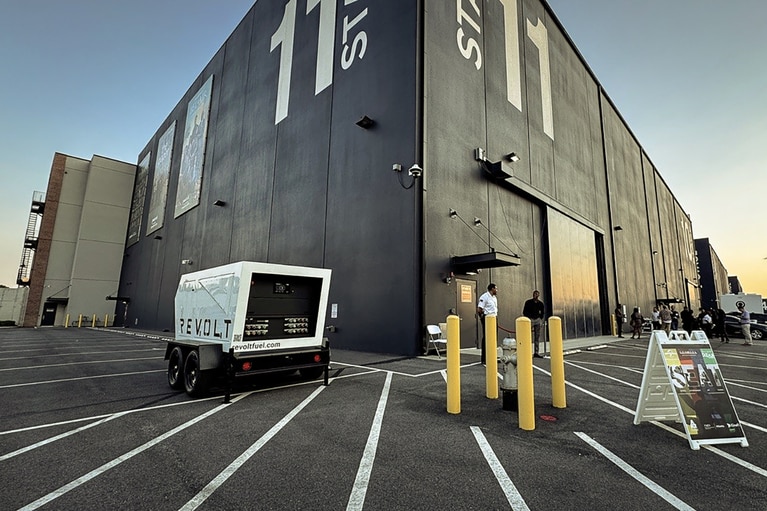
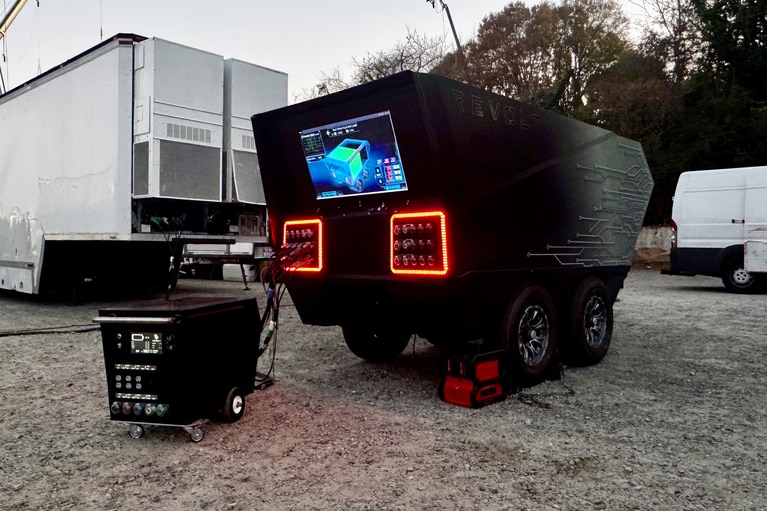
Figure 1: An example of a ReVolt mobile power unit.
EPDT: How has working with Vicor influenced your approach to power conversion architecture and system design?
JD: It shifted our whole mental model from ‘design a power supply’ to ‘compose a power system from proven modules.’ That’s a different discipline. Instead of trying to engineer the conversion stage ourselves, we treat it as a known-good block and put our design effort into integration, thermal, packaging and deployment, which is where our product actually differentiates. Vicor also raised the bar on how much we could reduce the form factor and fit into a smaller footprint. The density of the modules is what made a genuinely portable, field-deployable unit realistic rather than aspirational. That modular, factorized way of thinking about the power path is now core to how we design the whole line.
EPDT: From a system perspective, what differentiates ReVolt’s mobile power platforms in terms of efficiency, deployment and usability?
JD: The first is efficiency in the form of power on demand. A ReVolt unit delivers only what’s drawn from it and nothing when it’s idle. A diesel generator burns fuel regardless of load. A gen-set idling at 20% still burns a big share of its full-load rate and emits the whole time. ReVolt does not have idle burn. The second is deployment. The units are sized and packaged to easily move into position on a set or a site, and we right-size them up front. Our free online Power Calculator lets a coordinator or superintendent select their equipment, enter runtime and get a right-sized unit recommendation before anything ships. That way, customers don’t under-order and go dark, or over-order and pay for capacity they’ll never use. Usability is another key consideration. We use standard outputs that crews are already familiar with. And we offer near-silent operation and zero on-site emissions, which matters for crew health, neighbor complaints and clean audio tracks as much as for carbon reduction. Every customer also gets a real-time portal showing kWh delivered, diesel avoided and CO2 offset per job. And there’s one differentiator diesel physically can’t match — on vertical construction, our units capture regenerative braking energy from descending hoists and elevators back into the pack, instead of dumping it as heat through a braking resistor. Every descent cycle becomes a free charge. Lastly, our mobile app and online portal allow for remote monitoring and incremental voltage bumps.
EPDT: Beyond the hardware itself, how valuable has Vicor’s engineering expertise and support been throughout development and deployment?
JD: As valuable as the parts, frankly. Beyond the modules themselves, it’s the applications engineering — design-in support, reference designs, plus help characterizing the conversion and thermal behavior for our specific use case. For a team that came up through production rather than electrical engineering, that support de-risked the design and kept us moving at a pace we couldn’t have hit alone. It’s the difference between buying a component and gaining an engineering partner.
EPDT: ReVolt is contributing to broader electrification. How could your technology support more sustainable energy use across temporary and mobile power applications?
JD: Temporary and mobile power is the overlooked lever in electrification. On a film production, fuel in the form of vehicles and generators is roughly 50% of the total carbon footprint, and the generator share is the part nobody used to name. We’ve deployed 2.25MW of clean, battery-based power to date across film, TV and construction — not a pilot, a working fleet displacing diesel at point-of-use in exactly the places most sensitive to air and noise pollution. The bigger shift is in the model itself. As grid strain and regulation climb together, the question stops being ‘how much diesel can we safely burn?’ and becomes ‘how do we deliver the exact power needed, when it’s needed, with a full audit trail?’ That’s what our calculator and client portal are built around — right-size up front, then measure and report every kWhr, gallon of diesel avoided and pound of CO2 offset. On vertical construction, regenerative capture recovers energy diesel just throws away as heat. Across the industry, battery power is moving from the exception to the default, with diesel as the fallback - and high-density conversion is what makes that practical in the field.
EPDT: Which adjacent markets could benefit from your technology beyond film?
JD: Construction is the biggest and the fastest-moving, especially vertical builds where the regenerative-braking advantage is real and where the regulatory pressure is hardest — NYC, LA, and London low-emission and anti-idling zones, the EU’s Stage V non-road emissions rules, plus the UK’s target to pull 78% of diesel plant off construction sites by 2035. Mobile battery power is the compliance path. Beyond that, the same platform fits anywhere the grid isn’t practical and diesel is currently the default. That includes live events and festivals, outdoor broadcast, disaster relief and emergency power, remote telecom and infrastructure sites, agriculture and EV charging in grid-constrained locations. The common thread is identical to film — quiet, clean, measurable power delivered exactly where and when it’s needed, without a fuel tank.
This article was originally published by Electronic Product Design and Test.
Arrow: Driving the future of industry in robotics, industrial IoT, and intelligent automation seminar 2026
Industry-leading power density and innovative architectures of Vicor power modules for robotics, industrial IoT, and intelligent automation
Microgate’s out-of-this-world mission requires precision power
Microgate and Vicor power the world's largest telescope! Vicor’s modules deliver 10kW to 5400 actuators, helping Microgate eliminate space image distortion
Revolt is tackling the film industry’s dirtiest production secret - CO2 emissions
ReVolt Fuel tackles the film industry emitting 700k tons of CO2 per year to deliver clean on-set electricity with help of Vicor power modules
11 ways to fine tune your high-voltage-to-48V power conversion
Converting high-voltage to 48V DC slashes cabling costs and weight, significantly boosting energy efficiency across data centers and industrial systems