

Arrow: Driving the future of industry in robotics, industrial IoT, and intelligent automation seminar 2026
Industry-leading power density and innovative architectures of Vicor power modules for robotics, industrial IoT, and intelligent automation


Rising power demands across industrial, automotive, and defense sectors are forcing a shift from high-voltage systems down to lower 48V safety extra-low voltage (SELV) levels. Unlike AC distribution, this purely resistive DC setup eliminates reactive energy losses to drastically optimize performance. By transitioning to a 48V distribution network, industries can use thinner and lighter wiring that slashes material costs while curbing operational expenses through reduced thermal dissipation.
By Maury Wood, VP Strategic Marketing
Today’s new and existing electrification applications in the industrial, automotive, data center and defense sectors require more power. They are driving the need for higher voltages and conversion to lower DC SELV (safety extra-low voltage) levels – defined as below 50VDC. Often SELV level is 48VDC or 28VDC.
High voltage (HV) DC applications include 400V or 800V electric vehicle battery packs, AI data center 400V or 800V distribution to racks, with both electrical system architectures often converting to 48V. These principal HV-to-SELV use cases have created an ecosystem of components such as DC-DC converters, competence and know-how, and successful system design and deployment. Other HV to SELV application examples include solar and fuel cell power generation, long-distance subsea cables, large industrial robots, medical imaging systems, shipboard and aircraft power distribution, semiconductor ion implantation equipment. Telecom equipment has used –48VDC battery backup for decades, derived from 300VDC rectified from 220VAC from the utility grid.
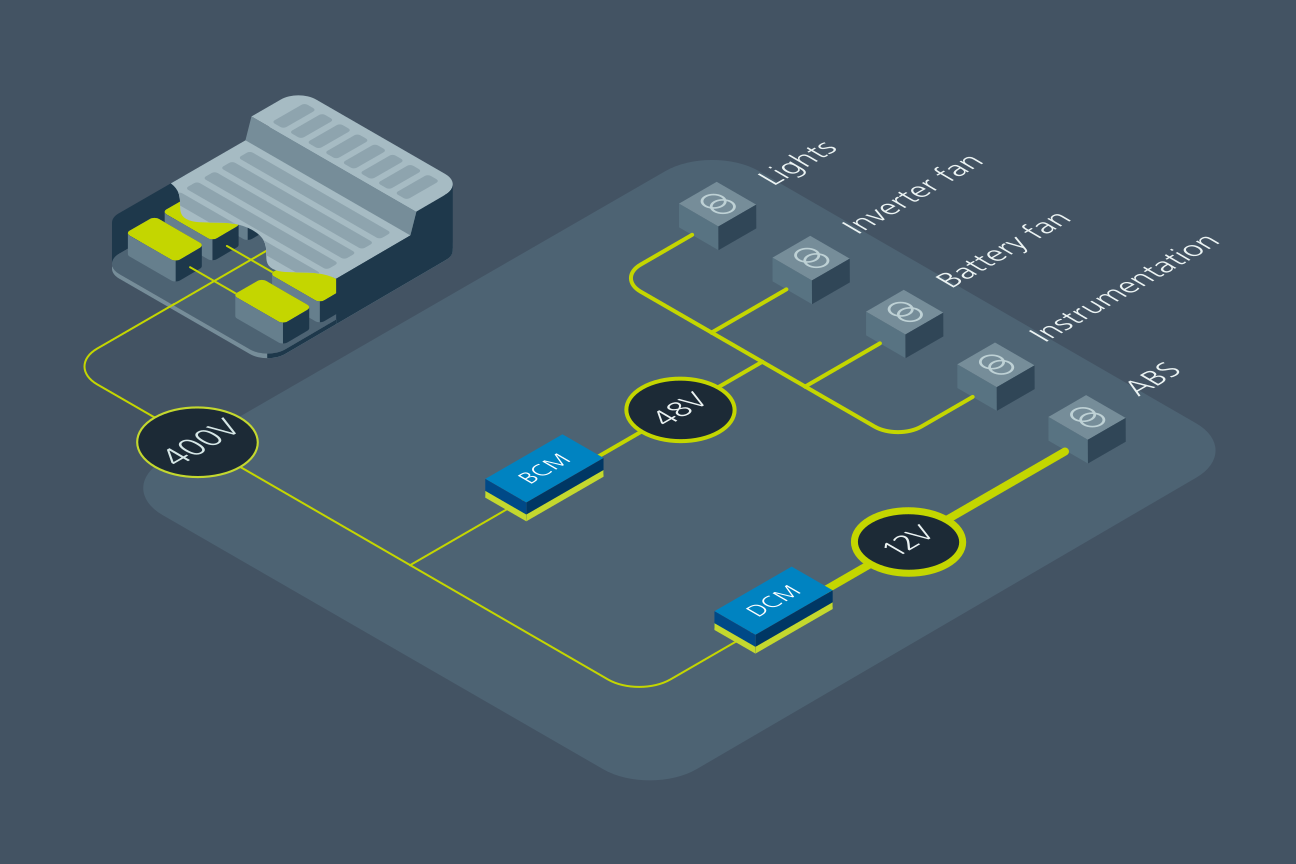
Figure 1: A light electric vehicle’s power delivery network converts a high-voltage battery source to a 48V bus using a fixed-ratio DC-DC Bus Converter Module (BCM®).
Unlike AC transmission systems such as utility grids, DC transmission systems do not have an electrically reactive (capacitive and inductive) component and are thus generally more efficient. DC distribution is purely resistive. (AC distribution also experiences resistive losses.) High-voltage cables have lower conductive thermal losses (I2R), are thinner and lighter and use less copper, an expensive commodity base metal due to the explosion of AI data centers among other factors.
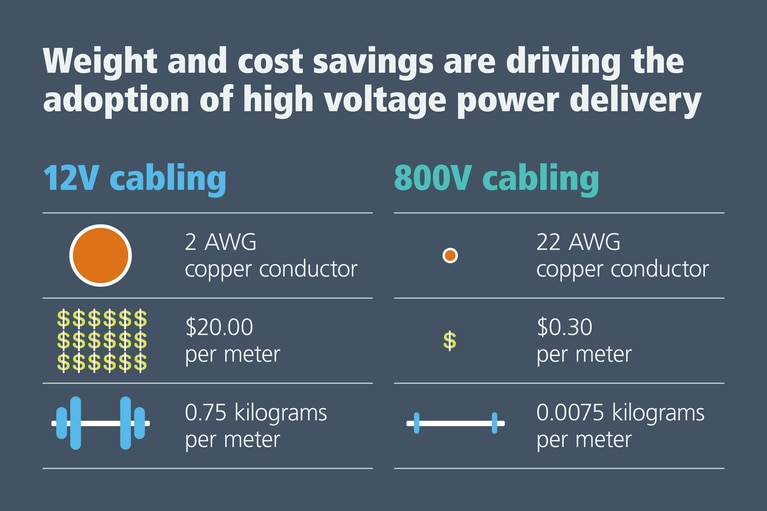
For example, to carry the same level of power, a 12V cable needs to carry 64x more current than an 800V cable. The 12V cable might use a 2AWG copper conductor (approximately $20 per meter) while the 800V cable might use a 22AWG copper conductor (approximately $0.30 per meter), which is obviously a substantial cost difference for long cable runs. Furthermore, the weight difference between 2AWG cable and 22AWG cable is about 0.2kg per meter. These key factors are driving the increasing adoption of DC power delivery, particularly in platforms in which are weight and cost sensitive.
Figure 2: High-voltage cabling provides not only low cost, but also higher efficiency and critical weight savings for products that require longer runtime. All other electrical parameters assumed equal (specifically cable resistance), 12V cabling dissipates 16x the losses of 48V cabling while delivering the same power to the load.
Resistive thermal dissipation in the cables used for high-power distribution can also be a major OPEX consideration beyond the CAPEX savings described above. Due to the extremely high power levels in AI data centers in the assessment of the Power Usage Effectiveness (PUE) of AI data centers, for example, approximately 6% of the incoming AC grid power is consumed by power conversion losses. If high-voltage distribution to the rack saves just 1% of this power conversion (a conservative estimate), then for a 1GW system, it represents a savings of 10MW. At $50 per MW/hr x 8,760hr/yr, this is $438k OPEX savings per year. Depending on the source of the energy, this is also a substantial reduction of greenhouse gases. Using natural gas power generation for comparison, 10MW produces about 4,000kg of CO2 per hour or 35Mkg per year.
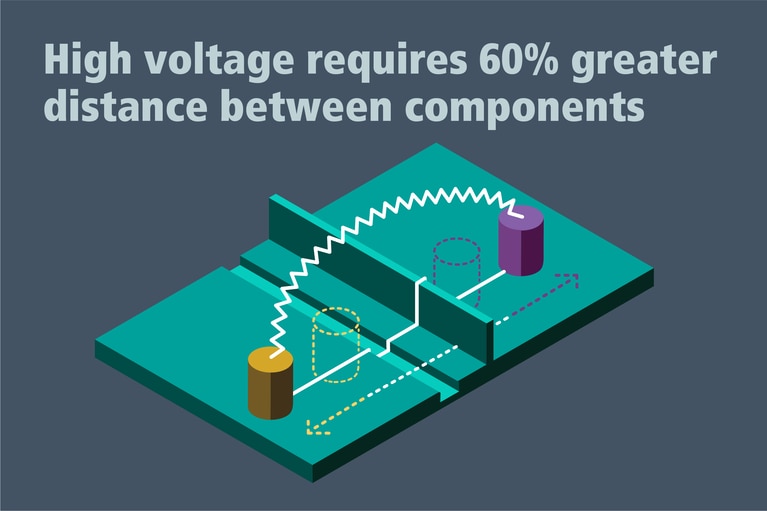
Figure 3: Creepage and clearance requirements are international safety measures to mitigate the risk of arcing. Lack of proper distancing may result in excess heat, directly damaging or compromising the power delivery network. Higher voltage requires up to 60% greater space in between components, a specification at odds with designing for a smaller power delivery footprint.
High-voltage conductors are often identified (to technicians and first responders) with orange insulation for safety reasons. This can be easily observed in electric vehicles.
High voltage sources must be galvanically isolated for human and system safety; isolation also eliminates ground loops and reduces noise. This is critically important. The isolation should be 2x to 4x working voltage isolation (conservatively 3.2kV for 800V applications).
Other challenges with high-voltage DC includes providing sufficient creepage (the shortest distance along the surface of an insulator between two conductors) and clearance (the shortest distance through the air between two conductors) for electrical safety concerns such as electric shock, fires and equipment failure. This applies both to discretely-implemented solutions and modular solutions. Insufficient creepage or clearance can cause arcing, shorts and breakdowns, particularly at high voltages and as environmental contamination increases over time. UL and IEC safety standards require sufficient creepage and clearance to ensure product reliability.
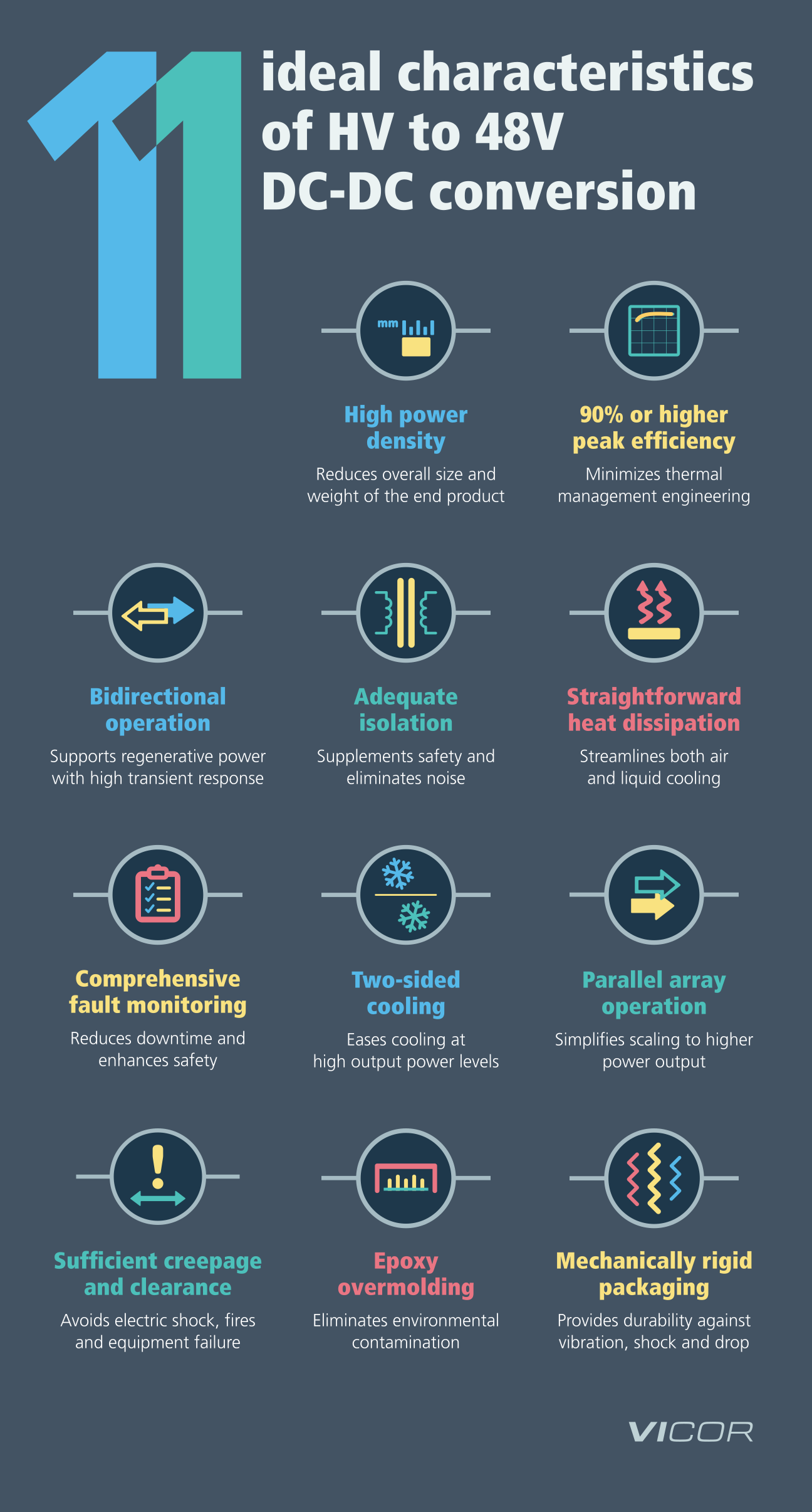
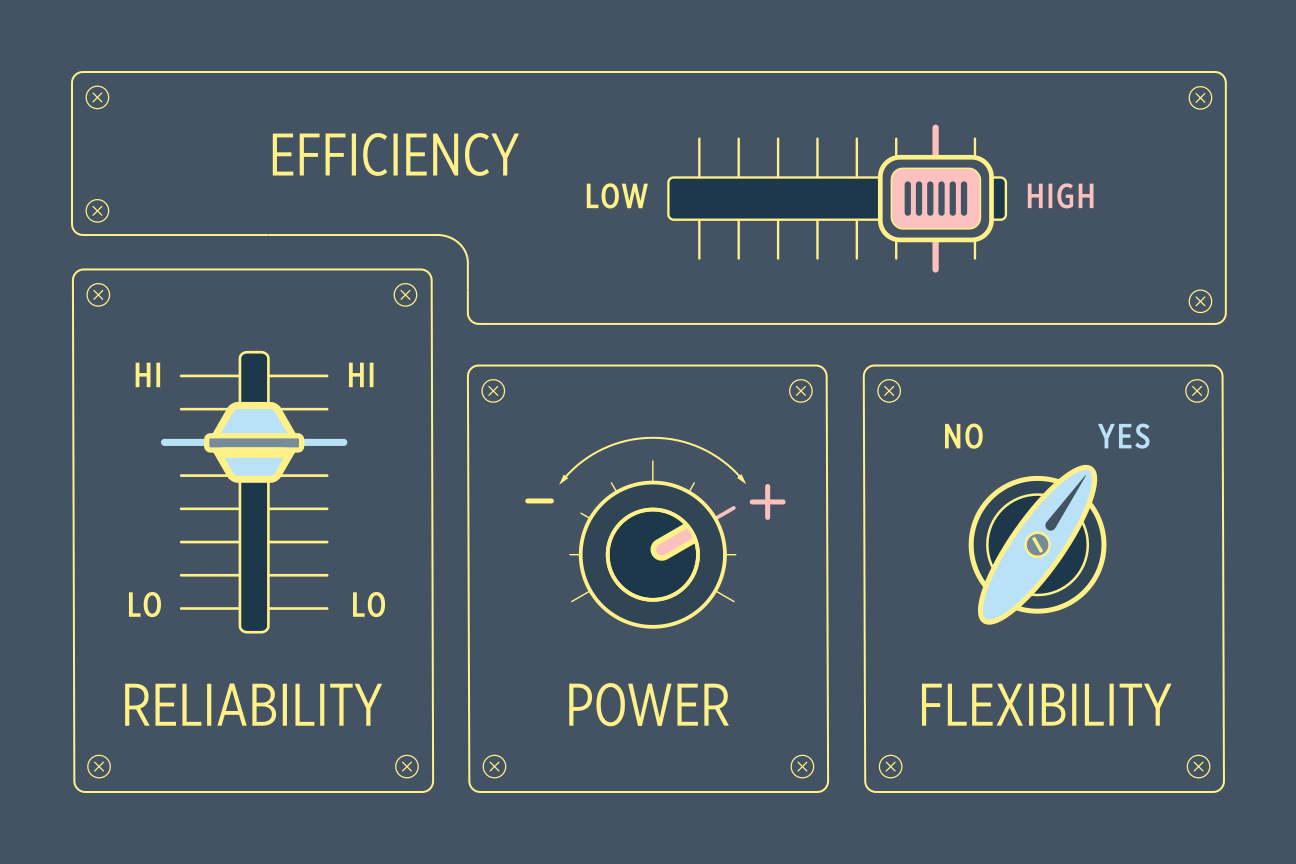
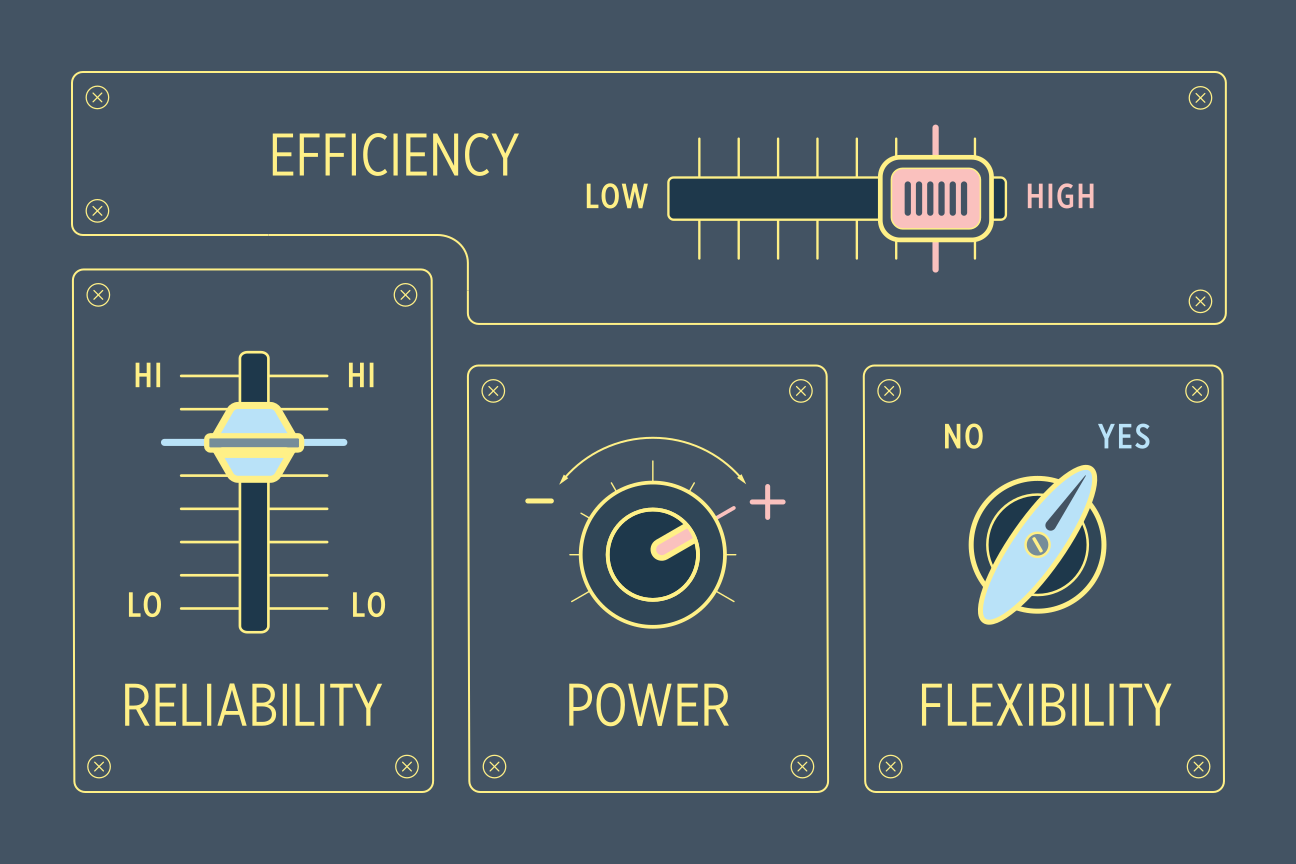
Figure 4: There are 11 important requirements to keep in mind when designing a power delivery network that is converting high voltage to a 48V bus.
To help accelerate the adoption of 48V PDNs, Vicor has developed a comprehensive ecosystem of power modules optimized for 48V applications. These modules are characterized by high power density (W/in3) and high current density (A/mm2). The Vicor modular approach enables designers to architect end-to-end 48V systems using building blocks that are:
Thermally adept module packages, combined with high functional integration shortens design cycles, reduces engineering risk and enables scalable designs across a wide range of power levels.
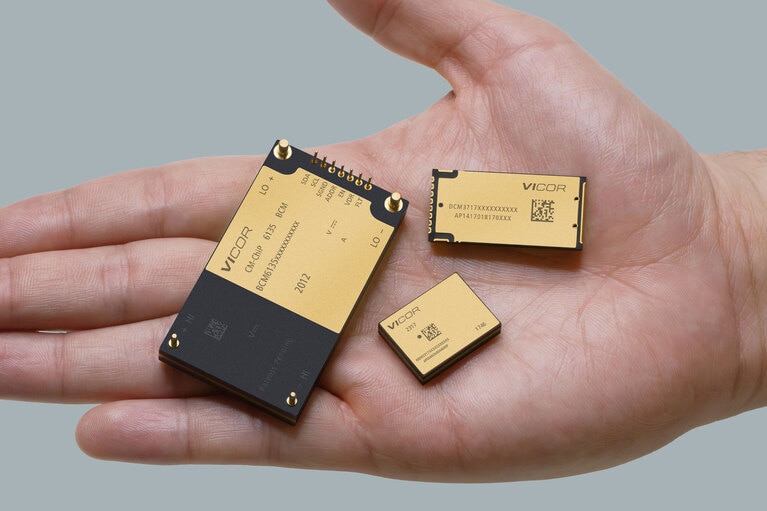
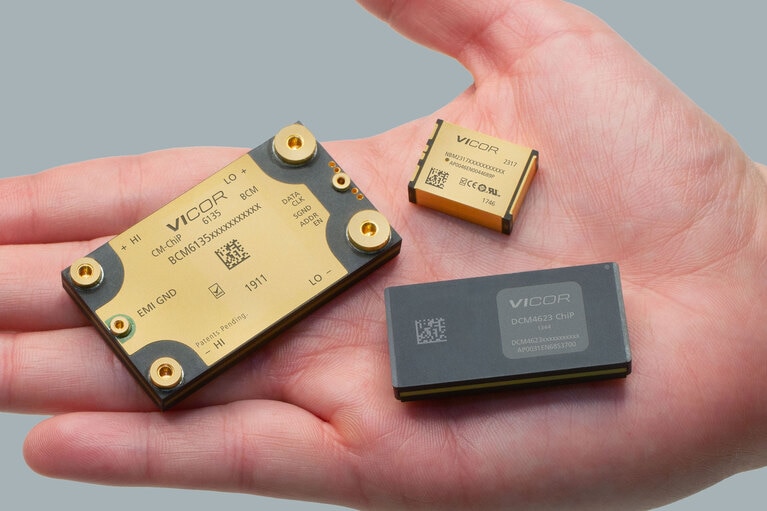
Figure 5: Vicor high-performance power modules provide kilowatts of power in a small space.
The Vicor portfolio includes solutions for all three elements of the 48V ecosystem:
This article was originally published by Power Electronics Europe.
Maury Wood is Vice President of Strategic Marketing at Vicor Corporation. Prior to joining Vicor, Maury held senior roles at optical fiber test and semiconductor companies, including EXFO, AFL, Broadcom, NXP, Analog Devices, and Cypress. He holds a BSEE from the University of Michigan and did graduate studies at Northeastern University, Babson College, and MIT. He enjoys climbing, back-country skiing, mountain biking, and playing jazz bass.
Maury Wood, VP Strategic Marketing
Arrow: Driving the future of industry in robotics, industrial IoT, and intelligent automation seminar 2026
Industry-leading power density and innovative architectures of Vicor power modules for robotics, industrial IoT, and intelligent automation
Microgate’s out-of-this-world mission requires precision power
Microgate and Vicor power the world's largest telescope! Vicor’s modules deliver 10kW to 5400 actuators, helping Microgate eliminate space image distortion
Revolt is tackling the film industry’s dirtiest production secret - CO2 emissions
ReVolt Fuel tackles the film industry emitting 700k tons of CO2 per year to deliver clean on-set electricity with help of Vicor power modules
11 ways to fine tune your high-voltage-to-48V power conversion
Converting high-voltage to 48V DC slashes cabling costs and weight, significantly boosting energy efficiency across data centers and industrial systems